5 Things to Know About the Retirement Saver’s Credit

1. You’re allowed to claim the saver’s credit and take the IRA deduction on your tax return.

The Retirement Saver’s Credit is a credit available to those who’ve made contributions to their traditional or Roth IRA, as well as to employer-sponsored retirement plans. The credit is an offset on your income tax.

An IRA deduction is an adjustment to your income. It lowers your taxable income, resulting in a lesser tax.

2. You need to meet 3 requirements to claim the saver’s credit.

     1. Be older than 18.

     2. Can’t be claimed as a dependent by anyone.

     3. Can’t be a student.

3. You can’t claim the credit if your contribution was the result of a rollover from one plan to another.

4. The credit will only apply to a maximum contribution amount of $2,000 ($4,000 for married filing jointly).

For example, if you’re single and contribute $3,500 to your retirement plan, only $2,000 will count towards the credit.

5. The amount of the credit has AGI limits.

Depending on your adjusted gross income (line 11 on Form 1040), your credit will be capped at 50%, 20%, or 10% of your contribution amount.

The following table shows the limits for 2023.
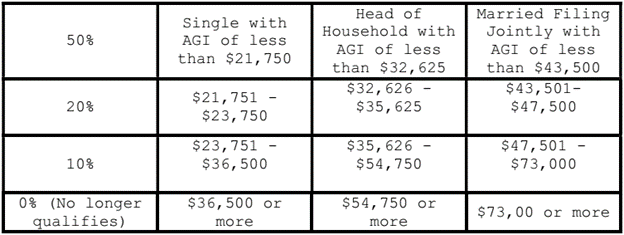
Using the previous example, if you’re single and made a $3,500 contribution only $2,000 qualifies for the credit. And if your AGI was $19,000 you’re due a credit of $1,000 (50% of contribution amount).

For more information visit the IRS’s retirement page.

Getting Paid in Virtual Currency

If you’re self-employed and are considering virtual currency as a payment method, you’ll be surprised to find that not much will change for you in terms of tax reporting. That being said, there’s still a few details to go over.

First, the IRS classifies virtual currency (or digital assets) as property, not cash. Virtual currency falls in line with other property like stock. So, when you provide a service and get paid with virtual currency, you’re exchanging a service for a property.

As an independent contractor, you’re still obligated to report income over $400 on your Schedule C and to pay self-employment tax on that income. The individual or company that paid you still has to report payments made to you over $600 to the IRS. In this regard nothing has changed.

The only thing that has changed is how you calculate the income you receive. In a regular cash transaction, let’s say you charge $100 for your service, the buyer pays you and you report those $100 straight on your return. If you receive virtual currency, you’ll have to report the Fair Market Value (in US dollars) of that payment. The FMV is what the currency was going for on the market on the day you received it. This makes it important to keep detailed track of your virtual receipts.

It’s possible you might not receive any tax form showing your income in virtual currency. You’ll still have to report it. For a few years now the IRS has added a question at the top of the 1040 asking if you’ve received or sold digital assets. If you got paid in virtual currency, click “Yes”. Although slowly, the IRS is cracking down on taxpayers who might owe taxes because of virtual currency transactions.

Tax Rules for Students Working

Scenario: An 18-year-old college student, who is claimed as a dependent on his parents’ tax return, decides to get a job. He wants to know how this will affect his parents’ return. 

There are three main concerns when a student takes up a job while being claimed on his parents’ tax return.

#1. Can my parents still claim me?

Your parents can still claim you even if you get a job, so long as you’re still under the age of 24 at the end of the year, remain a student, and you don’t provide over half of your support. Technically, you’re supposed to live with your parents, unless the only reason you’re not is because you’re going to school.

#2. Do you have to file a tax return?

Maybe. As a dependent, there are certain filing requirements you must meet to be required to file.

If your income comes solely from a W2 job and you haven’t married, you must have made over $12,550 (for the 2022 tax year). If you made less than this, you might still want to file if a refund is in order. Which leads us to our third concern.

#3. If I file, will I owe?

How much you’ll get back or owe boils down to your standard deduction. As a dependent, your standard deduction is the larger of $1,100 or the income you earned plus $350 (but not more than $12,550).

For example, you got a summer job and made $5,600. Your standard deduction is the larger of $1,100 or $5,600 plus $350. Your standard deduction is $5,950. On a straight-forward return like this, taxable income is 0 and there’s very likely a refund.

Note: It’s important for you and your parents to be on the same page. The best course of action is to consult a tax professional before getting a job to have a higher degree of certainty of what to expect come tax time.

Are Social Security Benefits Taxable?

If your only income comes from social security benefits, generally there’s nothing to report and your benefits are not taxable.

If, however, you have additional income such as wages, pensions, capital gains, dividends, and interest, you will have to figure out how much is taxable, if any.

To figure out if any of your benefits are taxable you take 1/2 of your benefits and add it to your additional income. If you’re married and file jointly, you’ll have to combine both incomes. If you’re married and file jointly and your spouse isn’t receiving benefits yet, you’ll still have to combine incomes. If your income is more than your “base amount”, some of your benefits might be taxable.

Base amounts are based on filing status. For 2022 the base amounts were:

Single, head of household, and qualifying surviving spouse have a base amount of $25,000.

Married filing jointly has a base amount of $32,000.

Married filing separately (and lived apart from your spouse) has a base amount of $25,000.

Married filing separately (and lived with spouse) has a base amount of $0.

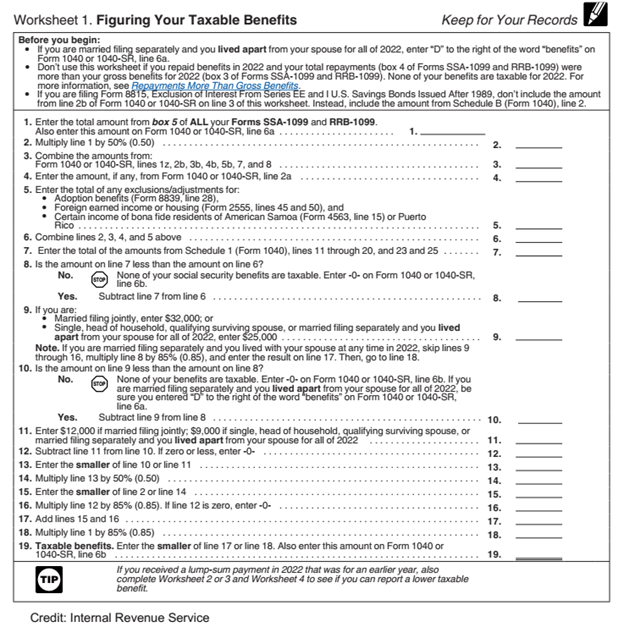
It’s important to note that even if your benefits are not taxable because you did not go over your base amount, you might still need to file a tax return to report your additional income. To find out how much of your benefits are taxable, if any, you’ll have to fill out Worksheet 1, found in the most current Publication 915 of the IRS.

If part of your benefits is taxable, and you anticipate this to be the case for future years, it’s important to prepare for a tax increase. One way to handle a higher tax is to have tax withheld from your benefits. You’ll need to submit Form W-4V with the Social Security Administration. Another option is to increase withholding on your other sources of income.

Form W9 For Independent Contractors

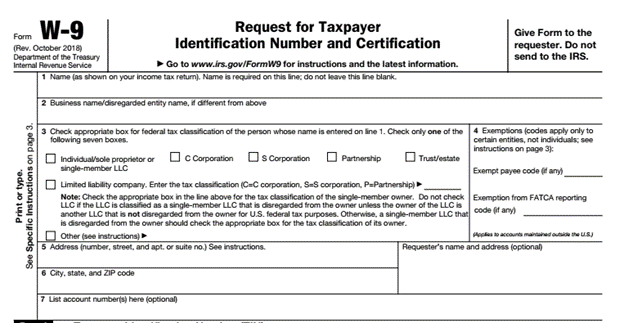
If you’re planning on doing freelance work for a business, either a company or another independent contractor, they might have you fill out Form W9. This is typically the case if they’re expecting to pay you over $600.

The reason they have you fill this form out is because they’ll need your name and TIN (ssn or itin) for them to report your earnings to the IRS. This way, they can deduct what they paid you and have written evidence of that deduction. They send Form 1099-NEC (formerly 1099-MISC), to you and the IRS.

Filling out the form is very straightforward.

Line 1: Your name as it’s registered at the Social Security Administration.

Line 2: If you’ve registered your business under a fictitious business name, that name will go here. If you don’t have a FBN leave it blank.

Line 3: If you’ve never incorporated your business and have not applied for a corporate tax classification, check “Individual/sole proprietor”.

Line 4: Leave this section blank if you’re a sole proprietor (same as independent contractor) since you don’t qualify for any exemption to backup withholding (more on this later).

Line 5-6: Your address. This can be your home address if you operate from home, or your business address if you have an office.

Line 7: You can leave this blank.

Part I: If you have either a social security number or ITIN, write that down here. If you operate under an Employer Identification Number, you can write that instead.

Part II: Read certification, then sign and date if you comply.

Will they take taxes out of your checks?

They shouldn’t. Unlike a W2 job, the business giving you work is not responsible for submitting your taxes to the IRS. You’re solely responsible for paying your own tax.

Check out this post for more information on making estimated tax payments.

There is the matter of “backup withholding”, but this doesn’t apply to independent contractors unless they failed to provide their correct name or TIN.

The Tax Factor In Cash Value Life Insurance

Cash value life insurance is a type of permanent life insurance. It provides death benefits, as well as a savings feature. Each premium gets split into policy coverage and investment. It is this investment portion that provides the life insurance with its cash value.

Much of the interest in cash value life insurance originates in retirement planning. If it will provide sufficient supplemental income is something that a financial advisor and a policy agent can discuss.

Cash value life insurance grows tax-deferred. So, the interest it accumulates does not get taxed during the lifetime of the policy. Interest is only taxable when it is withdrawn. There are two ways to keep withdrawals tax-free.

One way is to withdraw amounts only from deposits made towards the premiums (or your cash basis), and not those made towards the cash value. This is considered a return on principle, and it is not considered income.

A second way is to withdraw in the form of a loan. A loan will not be taxable; however, you will owe the loan plus interest to the insurance company.

Caution: it is possible to go over with withdraws from your account and end up withdrawing from the cash value. The danger of this is that you may end up lapsing the policy. If this happens, and you happened to have accumulated a substantial cash value, interest will become taxable in the year you withdraw it. Cash value life insurance offers the option to surrender the policy. This is essentially a total distribution of the policy (minus any surrender fees the company charges). If proceeds were more than your cash basis, proceeds will be reported on Form 1099-R.

It’s important to note that cash value is only available on permanent life insurance, not term life insurance. Cash value life insurance premiums are higher than on term policies, along with policy and surrender fees. It’s important to be prepared with a list of questions when speaking with both an advisor and an insurance agent in order to avoid costly surprises down the road.

What Happens When You Don’t File A Tax Return?

For many, filing a tax return is a requirement. It all boils down to a person’s filing status, age, and income.

So, what happens if you’re required to file but don’t?

If you’re due a refund you have three years to file in order to claim it. You’ll still be required to file your return; however, if you file after the three-year limit, you will no longer be eligible to receive that refund.

If you owe taxes and fail to file, the consequences can be more severe. The U.S. tax system is a pay-as-you-go system. We’re expected to pay our taxes as we earn our income, either through withholding or estimated payments. Every day we don’t file or pay our taxes past the tax deadline, penalties and interest accrue on that amount owed. We’re allowed to request an extension to file by October, but there is no extension for paying.

Section 6651(a)(1) of the Tax Code allows for a 5% “Failure to File Penalty” every month it isn’t filed. Section 6651(a)(2) allows for a “Failure to Pay Penalty” of .5% every month the tax isn’t paid. As of the 2nd Quarter of 2023, interest was kept at 7% for individuals (compounded daily).

It’s possible for the IRS to file a “substitute” return on your behalf. The IRS files such return using third-party reports such as W2s, 1099s, and any other tax documents submitted to them. You may lose out on credits and deductions if a substitute return is filed for you, potentially increasing your tax liability.

For those delaying filing a tax return because they owe, the IRS suggests filing anyway and requesting to be put on a payment plan. You can apply for a payment plan online or by calling the IRS at 800-829-1040.

Can You Deduct Gambling Losses?

Gambling winnings are reported on Form W-2G. Depending on the game, you’ll get it once you pass the winning threshold.

The chart below shows the minimum you must win to trigger a W-2G form from the following games.

It’s possible this additional income will lower your refund or increase a tax liability. This leads to the question: Can I deduct any gambling losses?

Taxpayers are allowed to deduct gambling losses up to their winnings. Meaning that if someone has winnings of $5,000, they can deduct losses up to $5,000 only.

Not everyone is able to claim losses, however. Losses are reported on Schedule A, the form used to claim itemized deductions.

Itemized deductions include mortgage interest, medical expenses, charitable contributions, certain personal taxes.

By default, most tax preparation software will give you the highest of either standard deduction or itemized deduction. So, if your itemized deductions are not more than your standard deduction the software will give you the standard deduction.

If you have enough itemized deductions to file Schedule A and decide to deduct your gambling losses, you have to keep accurate records of both winnings and losses.

The IRS suggests keeping a diary of winnings and losses. As well as keeping copies of records issued by the gambling establishments.

The diary should contain the following information:

  • The date and name of wager played.
  • The name and address of the gambling establishment.
  • Amounts won and lost.
  • Names of persons with you at the time of your wager.

The following IRS publications offer more information on the topics discussed above.

https://www.irs.gov/publications/p529

Is Alimony Deductible?

Alimony or separate maintenance payments are only deductible if executed under a divorce or separation instrument before 2019. Payments executed after 2018 are not deductible by the payer, nor are they taxable to the recipient. It’s possible for divorce or separation instruments executed before 2019 to be later modified to state that alimony is no longer deductible by the payer or taxable to the recipient.

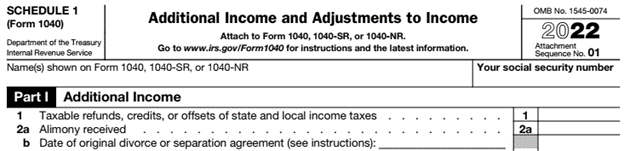
For those allowed to deduct alimony payments, they can do so on Schedule 1, line 19a.

For those having to report alimony payments received, they do so on Schedule 1, line 2a.

Both payer and recipient must include the social security numbers of their spouse or former spouse. If a taxpayer pays alimony to multiple individuals, the social security numbers of all individuals must be included. The same goes for a recipient receiving alimony from more than one individual.

How To Withhold More From Your Job To Pay Your Side Gig Tax.

Starting a new job means filling out a new Form W4. It’s easy to forget about that form if you stay at the same job longer than a year. It’s important to know that you can always go back and update your W4 whenever a change happens.

A change, for example, is signing up for a side gig that will report your earnings on a 1099. A side gig such as Uber or Doordash. In a situation like this, you’ll be solely responsible for paying your taxes directly to the IRS. This is a burden freelance workers must deal with.

Freelance workers are responsible for making quarterly payments to the IRS to cover their income tax and self-employment tax.

Another way to pay that tax is to increase your withholding at your current job. A common reaction to this advice is, “But they already take so much!” True, but the reality is, if your income is expected to increase so will your tax. You’ll owe that tax, whether you pay it now or later. The best course of action is to take control now.

One way to take control is to fill out a new Form W4, so that payroll can withhold enough to cover your side gig. You’ll need to include the expected freelance income and self-employment tax on the form.

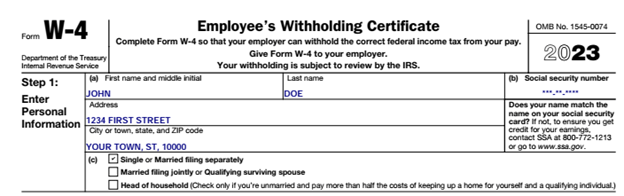
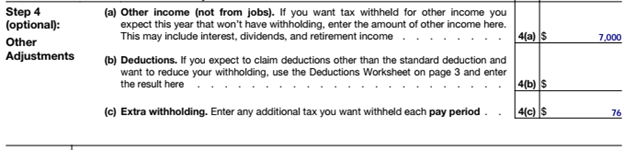
The following example shows how a single person with no dependents might fill out a new W4.

Step 1 is complete, and the single box has been checked off.

We’re going to skip steps 2 and 3, and complete Step 4.

This individual estimates that he will make $7,000 through his side gig, so he includes that amount on line 4(a). Payroll will add this amount to his earnings when calculating withholdings.

He ignores line 4(b) and completes line 4(c). The $7,000 side gig will be subject to the Self-Employment Tax. Extra withholding is meant to take care of that.

In this example, 7,000 is multiplied by 14.13% (SE Tax). The SE Tax on those $7,000 is roughly $989. Let’s assume John is halfway through the year and only has 13 more pay periods left. We divide 989 by 13 and get 76.

John is going to have an extra $76 withheld from his paychecks.

Although basic, this example is meant to take away the mystery out of Form W4 and give you more control over your tax planning.