Should You Be Making Estimated Tax Payments?

The US tax system is a pay-as-you-go system. Meaning that you must pay taxes as you earn income.

There are two ways of paying taxes. You can pay either through withholdings or by making estimated payments.

Individuals employed by others fill out Form W-4 to indicate how much should be withheld from their paychecks. Freelance individuals, however, are solely responsible for making those tax payments. They do this through estimated tax payments.

Should you be making estimated payments?

If you have decided to earn extra income on the side through one of the many gigs available, you might have to.

The following is a hypothetical tax scenario for a single person with one W2. The numbers used for wages and withholding are made up to simplify the tax calculation.
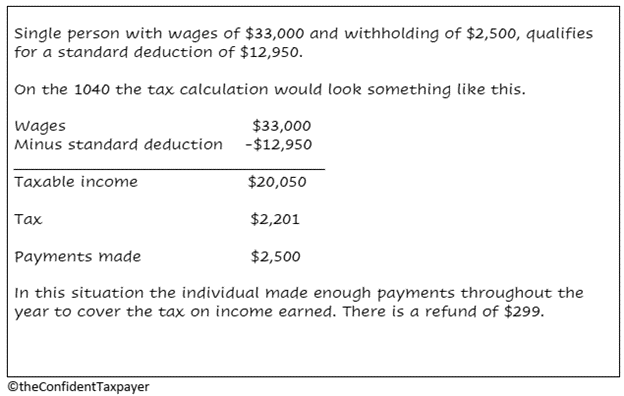
In this example the individual had enough withheld and will receive a refund. In a different example, however, this individual earned extra income through ridesharing.

In this second scenario estimated payments would have prevented a tax liability at tax filing time.

So how do you make estimated payments?

The first step is to estimate how much you will earn in the year. This will help you estimate the tax you will owe. Once you have this information you can break the estimated tax into four payments. Each payment has its due date.

Typically, the first payment is due April; second payment is due in June; third payment is due September; the fourth payment is due in January and can be paid along with the tax return.

Form 1040-ES provides worksheets to help calculate estimated taxes. The form also provides payment options accepted by the IRS.
https://www.irs.gov/forms-pubs/about-form-1040-es

What To Know About Deducting Business Miles

If you’ve started a business (or side gig), and use your car, you may be able to deduct the miles driven. If you use your car for both business and non-business purposes, you can only deduct the miles driven for business purposes.

Business miles are considered miles driven from your main place of business to other work locations. For example, if you rent an office and have to visit a client, you’re allowed to deduct the miles driven from your office to your client and back to your office. Miles driven from your home to your office are not deductible. These are considered commuting miles.

If you operate your business from your home, however, and visit clients, you’re allowed to deduct miles driven from your home to your clients.

You’re allowed to deduct business miles (also called the Standard Mileage Rate) if you choose this method the first year your car is available for business use. Meaning that you must use this method the first year you claim your car on your tax return.

You must also own or lease your car in order to use the SMR.

The following situations disallow the use of business miles:

  • Using 5 or more cars at the same time (as in fleet operations).
  • If you claimed a depreciation deduction for the car using any other method than the straight-line method.
  • If you claimed a Section 179 deduction on the car.
  • If you claimed the special depreciation allowance on the car.

If any of the previous situations apply, you must deduct actual expenses.

The burden of proof is always on the taxpayer, which makes mileage logs extremely important when it comes time to substantiate deductions taken.

A mileage log should include the following:

-Date and time of the business trip.

-Purpose of the trip.

-Miles driven on that trip.

Mileage can be tracked on spreadsheets, notebooks, apps, or any method the taxpayer chooses.

How To Withhold More From Your Job To Pay Your Side Gig Tax.

Starting a new job means filling out a new Form W4. It’s easy to forget about that form if you stay at the same job longer than a year. It’s important to know that you can always go back and update your W4 whenever a change happens.

A change, for example, is signing up for a side gig that will report your earnings on a 1099. A side gig such as Uber or Doordash. In a situation like this, you’ll be solely responsible for paying your taxes directly to the IRS. This is a burden freelance workers must deal with.

Freelance workers are responsible for making quarterly payments to the IRS to cover their income tax and self-employment tax.

Another way to pay that tax is to increase your withholding at your current job. A common reaction to this advice is, “But they already take so much!” True, but the reality is, if your income is expected to increase so will your tax. You’ll owe that tax, whether you pay it now or later. The best course of action is to take control now.

One way to take control is to fill out a new Form W4, so that payroll can withhold enough to cover your side gig. You’ll need to include the expected freelance income and self-employment tax on the form.

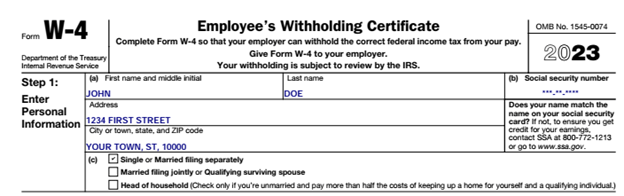
The following example shows how a single person with no dependents might fill out a new W4.

Step 1 is complete, and the single box has been checked off.

We’re going to skip steps 2 and 3, and complete Step 4.

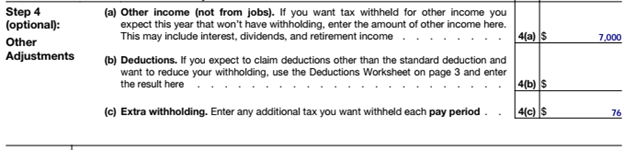
This individual estimates that he will make $7,000 through his side gig, so he includes that amount on line 4(a). Payroll will add this amount to his earnings when calculating withholdings.

He ignores line 4(b) and completes line 4(c). The $7,000 side gig will be subject to the Self-Employment Tax. Extra withholding is meant to take care of that.

In this example, 7,000 is multiplied by 14.13% (SE Tax). The SE Tax on those $7,000 is roughly $989. Let’s assume John is halfway through the year and only has 13 more pay periods left. We divide 989 by 13 and get 76.

John is going to have an extra $76 withheld from his paychecks.

Although basic, this example is meant to take away the mystery out of Form W4 and give you more control over your tax planning.

Are You An Employee or Independent Contractor?

Willfully or through mistake, an employer can categorize an employee as an independent contractor. There are tax implications that result from this. To prevent this error, find out what makes an employee. If you’ve been miscategorized, there’s a few things you can do to stop this from happening again.

There are 3 main factors that determine the category a person falls in at work. Keep in mind these factors are not black and white. The thing to look for is which category these factors lean towards the most.

  1. Behavioral control: an employee’s work is to a great extent controlled by the company. As opposed to an independent contractor who’s in charge of the work process.
  2. Financial control: if you’re an independent contractor you’re in charge of providing your own supplies and resources to get the job done. If you’re an employee your company should provide what you need.
  3. Relationship: the most important aspect of employer-worker relationships is the permanency of the relationship. Is the worker expected to continue working for the company after a specific project is over? Contracts also factor in; however, a contract may classify a worker as an independent contractor even though every other factor points to employee status.

Consequence of being miscategorized:

Of the two, employees tend to be put in the wrong category the most. Employers might do so out of ignorance or a desire to avoid payroll taxes. Aside from missing out on timely tax payments, employees also miss out on certain benefits like overtime and vacation days.

Things to look out for:

Most companies hire payroll companies to handle employee paychecks. There are employers who choose to do their own payroll. Regardless of who handles payroll each check should have a breakdown that includes gross pay, employee taxes, and net pay.

What to do if you’ve been miscategorized:

  1. Speak with your employer so that the issue can be corrected.
  2. If employer disagrees on status, you can file Form SS-8 with the IRS. The IRS will review the issue then decide.
  3. If the issue isn’t resolved, you can always contact your state’s labor department. In California, the Labor Commissioner’s Office oversees wage disputes.

If you start a job and are given form W-9 but suspect that it should be form W-4, discuss your doubts with your employer. It’s possible the employer isn’t aware of the mistake.