When The Children Grow Up- How To Adjust For Taxes

If you were used to receiving a refund because you claimed your children but can no longer claim them, the transition can be rough. The shock is common for parents, the first year they file without dependents. Refunds are considerably lower, or worse, there’s now a tax liability.

What to do?

If you’re paid wages or salary the easiest solution, from a tax point, is to update your W4. If you previously filed as head of household, and marked that status on your W4, you’ll want to go back and mark “single”.

If you’re self-employed and can no longer claim dependents the only solution available is to make estimated payments. These are quarterly payments that are meant to cover both your income tax and self-employment tax.

Estimated Payments

Taxpayers who expect to owe at least $1,000 on their tax return, and who are unable to have tax withheld, must make quarterly payments the year prior.

A good starting point is last year’s tax return. Your 1040 will show your gross income and expenses. If you expect your income and expenses to be similar, then your self-employment tax will also be similar. If you’re now filing single, instead of head of household, your income tax will be different, most likely higher.

Form 1040-ES offers worksheets that can help calculate accurate payments.

Tax Planning

Although you may still support your adult children, if they’ve fallen out of dependency eligibility for tax purposes, you’ll have to plan for a new tax scenario. Tax planning can be confusing, but hopefully this guide offers a good start for you.


You’re Going To Want To Keep Track Of Those Miles

If you plan on driving your car for business, in 2023, you might be able to deduct 65.5 cents per mile. If you drive for medical reasons the rate is 22 cents per mile. For charity, it’s 14 cents per mile.

Driving the same car for business and personal use will require you to calculate the use percentage for each. The miles driven for business are deductible, but the miles driven for personal use are not.

Business Miles

There are two methods of deducting the use of your car for business. There is the standard mileage rate (65.5 cents per mile), and there is actual use.

Standard mileage covers maintenance and repairs on your car, as well as gasoline and insurance. The 65.5 cent rate is a flat rate meant to cover all these expenses. You’ll have calculate which method will give you the biggest deduction.  

You can alternate between methods every year, but only if you opted to use the standard mileage rate the first year you used your car for business.

Medical Miles

Although medical miles have a lower rate than business miles, they follow the same rules. You can either deduct the standard mileage rate (22 cents per mile) or actual expenses. Unlike business miles, which are deducted on Schedule C, medical miles can only be deducted on Schedule A, Itemized Deductions.

To figure out which medical expenses are allowed by the IRS consult Publication 502, Medical and Dental Expenses.

Charity Miles

If you used your car to provide services to a qualified charitable organization, you can either deduct mileage (14 cents per mile) or actual expenses. These expenses must be unreimbursed and out-of-pocket.

Like medical deductions, charitable deductions must also be claimed on Schedule A.

Final Note

Burden of proof lies with the taxpayer. Any car deductions claimed on the tax return must be ready to be substantiated in the case of an audit.

Miles driven, and the purpose of those miles, must be made clear to the IRS through recordkeeping.

How To E-File 1099 Forms For Free

If you’re a business owner who’s hired independent contractors for services rendered to your business, you can e-file 1099 forms for free. Through the IRS’s Information Returns Intake System (IRIS), you can file 1099 returns, as well as print recipient copies.

1099 Requirements

If you paid an independent contractor over $600 in a tax year, you’re required to file a 1099-NEC Form with the IRS and issue the independent contractor a copy by January 31st.

As of 2023, if you must file 10 or more 1099 forms in a given tax year, you’re required to e-file them.

IRIS Taxpayer Portal

In order to use the IRIS portal you’ll have to submit an application to receive a Transmitter Control Code. This code will allow you access to the portal.

The application will require your business information and the information of the person submitting the application (also called a Responsible Office). The business must have an EIN, as social security numbers or ITINs are not acceptable.

How to Get an EIN

To get an EIN you’ll have to submit an application, providing your business information and the information of the Responsible Party. The Responsible Party is the person who exercises control over the business, like the owner. Most EINs are issued immediately.

More detailed information is provided in Publication 5717, Information Returns Intake Systems.

Why Self-Employed People Should Always Carry A Weekly Planner

A weekly planner isn’t just great for jotting down appointments. It can also serve as supporting documentation if the IRS were to ever audit your return. The U.S. Tax Court often makes it clear in case decisions that the burden of proof falls on the taxpayer claiming the deductions and credits. In the event of an audit, any unsubstantiated deduction will result in a higher tax bill.

But what should be written down? Even if you use third-party payment companies, such as Square, and pay for every expense with your debit card, it’s still beneficial to write down every sale and major expense to avoid discrepancies.

If you drive to clients’ homes or to any other business destination, it’s important to log in your mileage and destination to prove you are entitled to take the mileage deduction.

In a recent court case, a taxpayer’s mileage claim was disallowed after he was unable to back up his business mileage. Although he had a log of miles driven, he did not make it clear if the miles were for business or personal use. Writing down the purpose of the business trip could prevent a future disallowance.

Aside form helping you prepare an accurate tax return, a weekly planner can also help you manage your customer relationships. If you’re looking for recurring sales, knowing the date of your last visit can show your clients you haven’t forgotten them.

The Simplest Way to Deduct Your Home Office

There are two ways to deduct the use of a home office. You can deduct actual expenses, which provide for a higher allowable deduction. If you go this route, you’ll be bound by stricter requirements and more detailed reporting.

The IRS also allows taxpayers to use the Simplified Method. This method allows a deduction of $5 per square foot (limited to an area of 300 square feet).

The deduction is not allowed if a taxpayer has business expenses, unrelated to the use of a home office, that are greater than the gross income produced by the use of your home office.

If your business gross income is greater than your other business expenses, deduct the smaller of this difference or of the home office deduction.

Taxpayers who only had a home office for part of the year are limited to the average monthly square footage use. For example, if you started operating out of your home office in September, you’ll figure the average like this (assuming your home office use was 200 square feet):

((0+0+0+0+0+0+0+0+200+200+200+200)/12)=67 square feet

You home office deduction will be $335 ($5×67).

The simplified method is particularly helpful for self-employed individuals who rent. It’s easier to figure out and requires less recordkeeping. If you’re interested in deducting actual home office expenses, you can read more about Form 8829.

Tax Filing for Spouses Who Run a Business Together

It’s important, when spouses work together, that each spouse gets the social security and Medicare credit they deserve. It’s common for one spouse to file a Schedule C, claiming all income and expenses, when in fact, both spouses contributed equally to running their business.

The IRS generally requires married couples who run unincorporated businesses to file as partnerships. To limit the level of complexity, however, the IRS allows for the Qualified Joint Venture exception. This exception is available to married couples who:

1) file a joint return and are the only members of the venture.

2) materially participate in the business.

3) elect not to be treated as a partnership.

If you and your spouse qualify to file as a Qualified Joint Venture, you can each file a Schedule C. You’ll need to split the income and expenses according to each person’s interest in the business. For example, if both spouses were equally responsible and exerted the same level of control in the business it’s safe for each spouse to report 50% of the income and expenses on their respective Schedule Cs. You won’t necessarily pay more in taxes, but you will make sure each person’s social security and Medicare accounts are credited.

Note that the business must be co-owned by both spouses and must not be a state law entity. If you’ve registered the business with the state as an LLC, you no longer qualify as a Qualified Joint Venture and must file as a partnership. This involves filing Form 1065, in addition to Form 1040.

Tax Treatment of LLCs

One of the biggest misconceptions of individuals who register their businesses as LLCs with the state is that they’ll now be able to “pay themselves” from their business earnings.

It’s necessary to clarify how LLCs actually work, so that individuals can make the right decisions for themselves and their businesses.

An LLC is a legal entity bound by the laws of the state it was registered in. An LLC is not by default a corporation for tax purposes. If you are the sole owner and member of your LLC you’re considered a disregarded entity by the IRS. This means that for income tax purposes you’re still considered a sole proprietor, and will still have to file a Schedule C. The only time you’re considered a corporation is when you hire employees, in which case you’ll need to apply for an EIN in order to file employer tax returns such as Form 941.

You are not obligated to remain a disregarded entity, however. The IRS offers business owners the option to become either a C corporation or an S corporation (each with their own specific tax rules and consequences).

In short, an LLC does not offer by default favorable tax treatment to sole proprietors, unless they change their classification to a C corporation or S corporation. LLCs do offer business owners some legal protection to their assets and might still be a good business option. It’s important to discuss this topic with both a lawyer and a tax professional if you’re thinking of going this route.

For more information check out IRS Publication 3402, Taxation of Limited Liability Companies.

Getting Paid in Virtual Currency

If you’re self-employed and are considering virtual currency as a payment method, you’ll be surprised to find that not much will change for you in terms of tax reporting. That being said, there’s still a few details to go over.

First, the IRS classifies virtual currency (or digital assets) as property, not cash. Virtual currency falls in line with other property like stock. So, when you provide a service and get paid with virtual currency, you’re exchanging a service for a property.

As an independent contractor, you’re still obligated to report income over $400 on your Schedule C and to pay self-employment tax on that income. The individual or company that paid you still has to report payments made to you over $600 to the IRS. In this regard nothing has changed.

The only thing that has changed is how you calculate the income you receive. In a regular cash transaction, let’s say you charge $100 for your service, the buyer pays you and you report those $100 straight on your return. If you receive virtual currency, you’ll have to report the Fair Market Value (in US dollars) of that payment. The FMV is what the currency was going for on the market on the day you received it. This makes it important to keep detailed track of your virtual receipts.

It’s possible you might not receive any tax form showing your income in virtual currency. You’ll still have to report it. For a few years now the IRS has added a question at the top of the 1040 asking if you’ve received or sold digital assets. If you got paid in virtual currency, click “Yes”. Although slowly, the IRS is cracking down on taxpayers who might owe taxes because of virtual currency transactions.

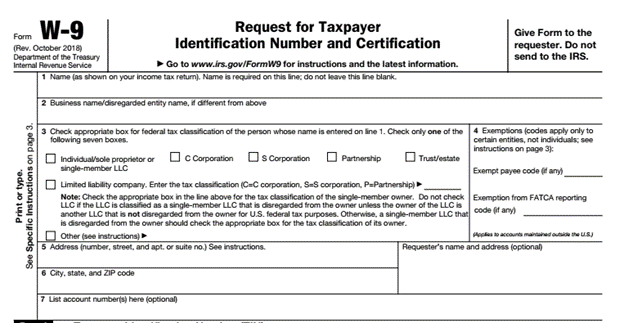
Form W9 For Independent Contractors

If you’re planning on doing freelance work for a business, either a company or another independent contractor, they might have you fill out Form W9. This is typically the case if they’re expecting to pay you over $600.

The reason they have you fill this form out is because they’ll need your name and TIN (ssn or itin) for them to report your earnings to the IRS. This way, they can deduct what they paid you and have written evidence of that deduction. They send Form 1099-NEC (formerly 1099-MISC), to you and the IRS.

Filling out the form is very straightforward.

Line 1: Your name as it’s registered at the Social Security Administration.

Line 2: If you’ve registered your business under a fictitious business name, that name will go here. If you don’t have a FBN leave it blank.

Line 3: If you’ve never incorporated your business and have not applied for a corporate tax classification, check “Individual/sole proprietor”.

Line 4: Leave this section blank if you’re a sole proprietor (same as independent contractor) since you don’t qualify for any exemption to backup withholding (more on this later).

Line 5-6: Your address. This can be your home address if you operate from home, or your business address if you have an office.

Line 7: You can leave this blank.

Part I: If you have either a social security number or ITIN, write that down here. If you operate under an Employer Identification Number, you can write that instead.

Part II: Read certification, then sign and date if you comply.

Will they take taxes out of your checks?

They shouldn’t. Unlike a W2 job, the business giving you work is not responsible for submitting your taxes to the IRS. You’re solely responsible for paying your own tax.

Check out this post for more information on making estimated tax payments.

There is the matter of “backup withholding”, but this doesn’t apply to independent contractors unless they failed to provide their correct name or TIN.

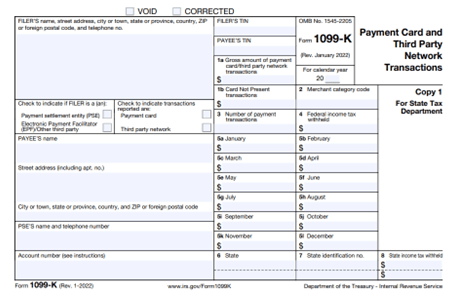
What Exactly Does A 1099-K Report?

If you’ve started your first business or side hustle, you should know the two payment transactions that will produce a 1099-K.

There are two ways of getting paid when you’re doing business online.

1. Card payments.

This is done through payment service companies. Square is one example of these companies. It is also a more direct way of getting paid by a customer.

2. Third-party networks.

Platforms, like eBay and Fiverr, that allow you to sell through them are third-party networks. Although you may interact directly with a customer, when you get paid it goes through the platform first.

Reporting requirements:

Payment service companies have no minimum reporting thresholds. This means that if you get paid $5 through them it’ll get reported and you’ll get a 1099-K form.

Third-party networks have a minimum reporting threshold of $600. They will produce a report once you earn more than that amount.

What to do with a 1099-K:

Amounts shown on this form are reported on line 1 of Schedule C.

If you run more than one business or side hustle in different industries, you’ll have to report 1099-K amounts on each respective Schedule C.

For example: if you sell video editing services on Fiverr, you have to file a Schedule C for that service. If you also do Uber on the side, that will require another Schedule C. So, the 1099-K form you receive from Fiverr will go on the Schedule C for that service; the 1099-K from Uber will go on your ridesharing Schedule C.

Fees:

Any fees charged to you by the company issuing you the 1099-K are not included in the form. To deduct those, you will have to report those on line 10 of Schedule C. Form 1099-K is a straightforward form. It reports the monthly amounts of either card payments or selling revenue you’ve received in the course of your business or side hustle for the year. Amounts reported go on the Schedule C, where you can also include any qualifying deduction you incurred while earning that money.