5 Things to Know About the Retirement Saver’s Credit

1. You’re allowed to claim the saver’s credit and take the IRA deduction on your tax return.

The Retirement Saver’s Credit is a credit available to those who’ve made contributions to their traditional or Roth IRA, as well as to employer-sponsored retirement plans. The credit is an offset on your income tax.

An IRA deduction is an adjustment to your income. It lowers your taxable income, resulting in a lesser tax.

2. You need to meet 3 requirements to claim the saver’s credit.

     1. Be older than 18.

     2. Can’t be claimed as a dependent by anyone.

     3. Can’t be a student.

3. You can’t claim the credit if your contribution was the result of a rollover from one plan to another.

4. The credit will only apply to a maximum contribution amount of $2,000 ($4,000 for married filing jointly).

For example, if you’re single and contribute $3,500 to your retirement plan, only $2,000 will count towards the credit.

5. The amount of the credit has AGI limits.

Depending on your adjusted gross income (line 11 on Form 1040), your credit will be capped at 50%, 20%, or 10% of your contribution amount.

The following table shows the limits for 2023.
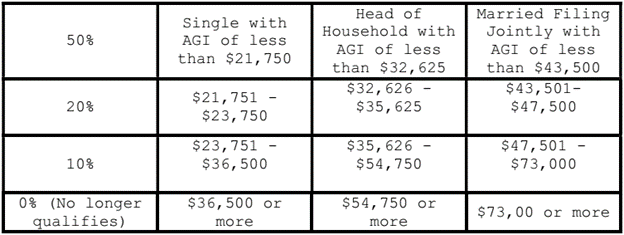
Using the previous example, if you’re single and made a $3,500 contribution only $2,000 qualifies for the credit. And if your AGI was $19,000 you’re due a credit of $1,000 (50% of contribution amount).

For more information visit the IRS’s retirement page.

Are Social Security Benefits Taxable?

If your only income comes from social security benefits, generally there’s nothing to report and your benefits are not taxable.

If, however, you have additional income such as wages, pensions, capital gains, dividends, and interest, you will have to figure out how much is taxable, if any.

To figure out if any of your benefits are taxable you take 1/2 of your benefits and add it to your additional income. If you’re married and file jointly, you’ll have to combine both incomes. If you’re married and file jointly and your spouse isn’t receiving benefits yet, you’ll still have to combine incomes. If your income is more than your “base amount”, some of your benefits might be taxable.

Base amounts are based on filing status. For 2022 the base amounts were:

Single, head of household, and qualifying surviving spouse have a base amount of $25,000.

Married filing jointly has a base amount of $32,000.

Married filing separately (and lived apart from your spouse) has a base amount of $25,000.

Married filing separately (and lived with spouse) has a base amount of $0.

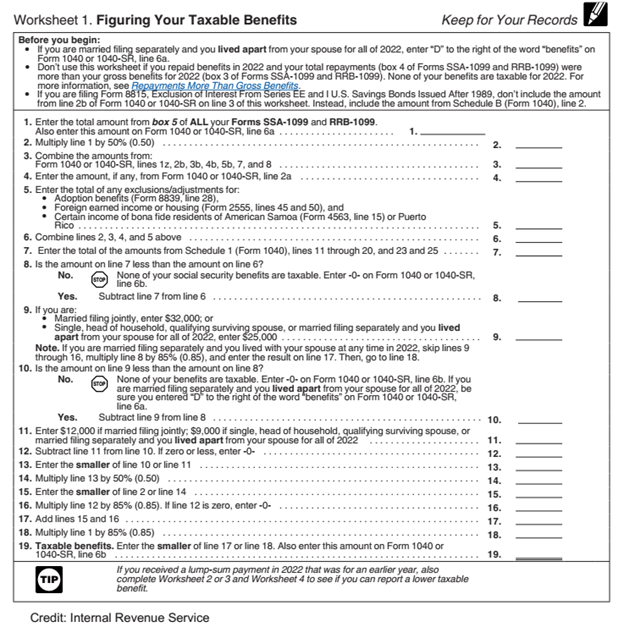
It’s important to note that even if your benefits are not taxable because you did not go over your base amount, you might still need to file a tax return to report your additional income. To find out how much of your benefits are taxable, if any, you’ll have to fill out Worksheet 1, found in the most current Publication 915 of the IRS.

If part of your benefits is taxable, and you anticipate this to be the case for future years, it’s important to prepare for a tax increase. One way to handle a higher tax is to have tax withheld from your benefits. You’ll need to submit Form W-4V with the Social Security Administration. Another option is to increase withholding on your other sources of income.

The Tax Factor In Cash Value Life Insurance

Cash value life insurance is a type of permanent life insurance. It provides death benefits, as well as a savings feature. Each premium gets split into policy coverage and investment. It is this investment portion that provides the life insurance with its cash value.

Much of the interest in cash value life insurance originates in retirement planning. If it will provide sufficient supplemental income is something that a financial advisor and a policy agent can discuss.

Cash value life insurance grows tax-deferred. So, the interest it accumulates does not get taxed during the lifetime of the policy. Interest is only taxable when it is withdrawn. There are two ways to keep withdrawals tax-free.

One way is to withdraw amounts only from deposits made towards the premiums (or your cash basis), and not those made towards the cash value. This is considered a return on principle, and it is not considered income.

A second way is to withdraw in the form of a loan. A loan will not be taxable; however, you will owe the loan plus interest to the insurance company.

Caution: it is possible to go over with withdraws from your account and end up withdrawing from the cash value. The danger of this is that you may end up lapsing the policy. If this happens, and you happened to have accumulated a substantial cash value, interest will become taxable in the year you withdraw it. Cash value life insurance offers the option to surrender the policy. This is essentially a total distribution of the policy (minus any surrender fees the company charges). If proceeds were more than your cash basis, proceeds will be reported on Form 1099-R.

It’s important to note that cash value is only available on permanent life insurance, not term life insurance. Cash value life insurance premiums are higher than on term policies, along with policy and surrender fees. It’s important to be prepared with a list of questions when speaking with both an advisor and an insurance agent in order to avoid costly surprises down the road.

Early Retirement Distribution Penalty- Explaining The Medical Exemption

A retirement distribution is considered early when it is distributed before the taxpayer turns 59 ½. In this case there is no 10% tax penalty attached to this distribution.

If a distribution is taken before turning 59 ½, not only is the amount taxable but there is an additional 10% tax penalty. The 10 percent penalty is calculated as 10 percent of the distribution. So, if you take out $5,000 from your 401K before turning 59 ½, you will have to include that amount to your other taxable income, as well as pay an additional $500 as penalty.

There is a list of exemptions that release taxpayers from that 10% penalty. One of those exemptions is the medical exemption, which is the subject of this post.

The 10% penalty is not imposed on taxpayers if early retirement distributions were used to pay for qualified medical expenses of the taxpayer, spouse, or dependent. Such medical expenses must not have been reimbursed at any point.

According to the Internal Revenue Code (72(t)2(B)), distributions must “not exceed the amount allowable as a deduction under section 213 to the employee for amounts paid during the taxable year for medical care (determined without regard to whether the employee itemizes deductions for such taxable year).”

Section 213 is the section that tells us that we can only itemize the medical expenses that exceed 7.5% of our adjusted gross income. For example, a taxpayer with an AGI of $45,000 can only itemize medical expenses in excess of $3,375.

As 72(t)2(B) states though, a taxpayer doesn’t have to itemize to qualify for the medical exemption to the early distribution penalty.

Using our previous example, let’s assume the taxpayer with an AGI of $45,000 had medical expenses of $7,000 (and did not itemize). According to section 213, she can only claim $3,625 in medical expenses ($7,000-$3,375).

In order to qualify for the medical exemption, her distribution must not have been more than $3,625.

As with any other claim on the 1040, burden of proof lies with the taxpayer. Records must be kept for every medical expense that qualifies you for the exemption.