Why Self-Employed People Should Always Carry A Weekly Planner

A weekly planner isn’t just great for jotting down appointments. It can also serve as supporting documentation if the IRS were to ever audit your return. The U.S. Tax Court often makes it clear in case decisions that the burden of proof falls on the taxpayer claiming the deductions and credits. In the event of an audit, any unsubstantiated deduction will result in a higher tax bill.

But what should be written down? Even if you use third-party payment companies, such as Square, and pay for every expense with your debit card, it’s still beneficial to write down every sale and major expense to avoid discrepancies.

If you drive to clients’ homes or to any other business destination, it’s important to log in your mileage and destination to prove you are entitled to take the mileage deduction.

In a recent court case, a taxpayer’s mileage claim was disallowed after he was unable to back up his business mileage. Although he had a log of miles driven, he did not make it clear if the miles were for business or personal use. Writing down the purpose of the business trip could prevent a future disallowance.

Aside form helping you prepare an accurate tax return, a weekly planner can also help you manage your customer relationships. If you’re looking for recurring sales, knowing the date of your last visit can show your clients you haven’t forgotten them.

Short Guide to Claiming the Used Clean Vehicle Credit

There are several good reasons to buy an electric vehicle. The main reason is the ever-increasing price of gas. It’s expensive going to work. For many who want to start a ride-sharing gig it just makes sense.

For several years now the IRS has offered people a credit for new electric vehicles. A new EV, though, may be out of range for many people’s budgets. For those who are aiming for a used EV, the IRS is now offering a credit to qualifying taxpayers.

To claim the credit, a taxpayer cannot be claimed on another’s return. The taxpayer must not be the original owner, must not have claimed a used clean vehicle credit in the 3 years before the current purchase, and must not have purchased the vehicle for resale.

Additionally, a taxpayer’s AGI must be under $150,000 if married filing jointly, $112,500 for heads of households, and under $75,000 if single or married filing separately.

To find a list of the current qualifying vehicles go to fueleconomy.gov. To qualify for this credit the vehicle must have a sale price of $25,000 or less and must have been purchased from a dealer.

The credit is claimed on Form 8936, for a maximum credit of $4,000. You’ll need the car’s VIN number. The dealer is also responsible for providing the following information:

  • Battery capacity
  • Sale date and sale price
  • Dealer’s name and tax ID

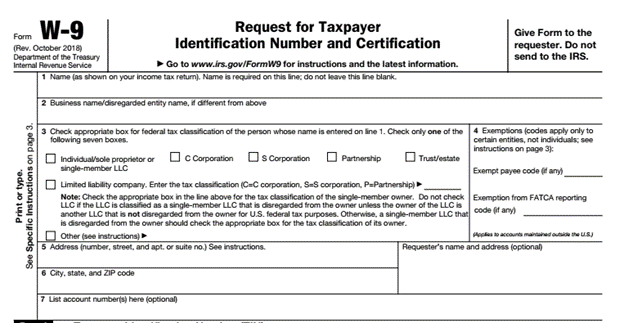
Form W9 For Independent Contractors

If you’re planning on doing freelance work for a business, either a company or another independent contractor, they might have you fill out Form W9. This is typically the case if they’re expecting to pay you over $600.

The reason they have you fill this form out is because they’ll need your name and TIN (ssn or itin) for them to report your earnings to the IRS. This way, they can deduct what they paid you and have written evidence of that deduction. They send Form 1099-NEC (formerly 1099-MISC), to you and the IRS.

Filling out the form is very straightforward.

Line 1: Your name as it’s registered at the Social Security Administration.

Line 2: If you’ve registered your business under a fictitious business name, that name will go here. If you don’t have a FBN leave it blank.

Line 3: If you’ve never incorporated your business and have not applied for a corporate tax classification, check “Individual/sole proprietor”.

Line 4: Leave this section blank if you’re a sole proprietor (same as independent contractor) since you don’t qualify for any exemption to backup withholding (more on this later).

Line 5-6: Your address. This can be your home address if you operate from home, or your business address if you have an office.

Line 7: You can leave this blank.

Part I: If you have either a social security number or ITIN, write that down here. If you operate under an Employer Identification Number, you can write that instead.

Part II: Read certification, then sign and date if you comply.

Will they take taxes out of your checks?

They shouldn’t. Unlike a W2 job, the business giving you work is not responsible for submitting your taxes to the IRS. You’re solely responsible for paying your own tax.

Check out this post for more information on making estimated tax payments.

There is the matter of “backup withholding”, but this doesn’t apply to independent contractors unless they failed to provide their correct name or TIN.

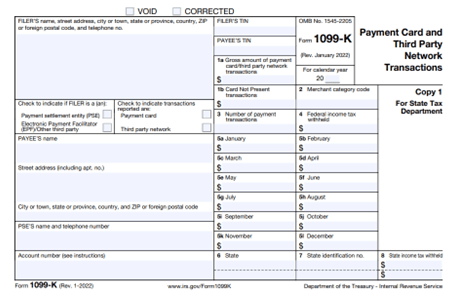
What Exactly Does A 1099-K Report?

If you’ve started your first business or side hustle, you should know the two payment transactions that will produce a 1099-K.

There are two ways of getting paid when you’re doing business online.

1. Card payments.

This is done through payment service companies. Square is one example of these companies. It is also a more direct way of getting paid by a customer.

2. Third-party networks.

Platforms, like eBay and Fiverr, that allow you to sell through them are third-party networks. Although you may interact directly with a customer, when you get paid it goes through the platform first.

Reporting requirements:

Payment service companies have no minimum reporting thresholds. This means that if you get paid $5 through them it’ll get reported and you’ll get a 1099-K form.

Third-party networks have a minimum reporting threshold of $600. They will produce a report once you earn more than that amount.

What to do with a 1099-K:

Amounts shown on this form are reported on line 1 of Schedule C.

If you run more than one business or side hustle in different industries, you’ll have to report 1099-K amounts on each respective Schedule C.

For example: if you sell video editing services on Fiverr, you have to file a Schedule C for that service. If you also do Uber on the side, that will require another Schedule C. So, the 1099-K form you receive from Fiverr will go on the Schedule C for that service; the 1099-K from Uber will go on your ridesharing Schedule C.

Fees:

Any fees charged to you by the company issuing you the 1099-K are not included in the form. To deduct those, you will have to report those on line 10 of Schedule C. Form 1099-K is a straightforward form. It reports the monthly amounts of either card payments or selling revenue you’ve received in the course of your business or side hustle for the year. Amounts reported go on the Schedule C, where you can also include any qualifying deduction you incurred while earning that money. 

Should You Be Making Estimated Tax Payments?

The US tax system is a pay-as-you-go system. Meaning that you must pay taxes as you earn income.

There are two ways of paying taxes. You can pay either through withholdings or by making estimated payments.

Individuals employed by others fill out Form W-4 to indicate how much should be withheld from their paychecks. Freelance individuals, however, are solely responsible for making those tax payments. They do this through estimated tax payments.

Should you be making estimated payments?

If you have decided to earn extra income on the side through one of the many gigs available, you might have to.

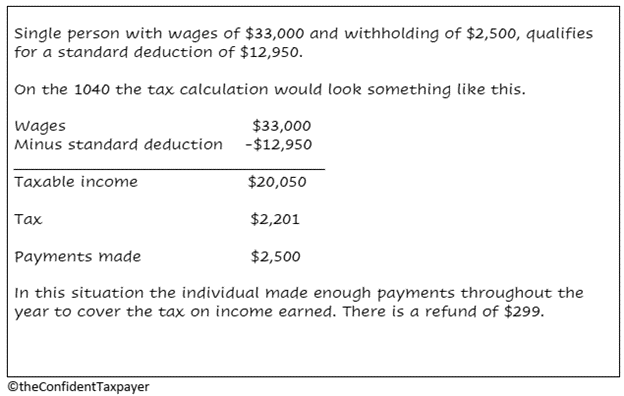
The following is a hypothetical tax scenario for a single person with one W2. The numbers used for wages and withholding are made up to simplify the tax calculation.

In this example the individual had enough withheld and will receive a refund. In a different example, however, this individual earned extra income through ridesharing.

In this second scenario estimated payments would have prevented a tax liability at tax filing time.

So how do you make estimated payments?

The first step is to estimate how much you will earn in the year. This will help you estimate the tax you will owe. Once you have this information you can break the estimated tax into four payments. Each payment has its due date.

Typically, the first payment is due April; second payment is due in June; third payment is due September; the fourth payment is due in January and can be paid along with the tax return.

Form 1040-ES provides worksheets to help calculate estimated taxes. The form also provides payment options accepted by the IRS.

https://www.irs.gov/forms-pubs/about-form-1040-es

How To Withhold More From Your Job To Pay Your Side Gig Tax.

Starting a new job means filling out a new Form W4. It’s easy to forget about that form if you stay at the same job longer than a year. It’s important to know that you can always go back and update your W4 whenever a change happens.

A change, for example, is signing up for a side gig that will report your earnings on a 1099. A side gig such as Uber or Doordash. In a situation like this, you’ll be solely responsible for paying your taxes directly to the IRS. This is a burden freelance workers must deal with.

Freelance workers are responsible for making quarterly payments to the IRS to cover their income tax and self-employment tax.

Another way to pay that tax is to increase your withholding at your current job. A common reaction to this advice is, “But they already take so much!” True, but the reality is, if your income is expected to increase so will your tax. You’ll owe that tax, whether you pay it now or later. The best course of action is to take control now.

One way to take control is to fill out a new Form W4, so that payroll can withhold enough to cover your side gig. You’ll need to include the expected freelance income and self-employment tax on the form.

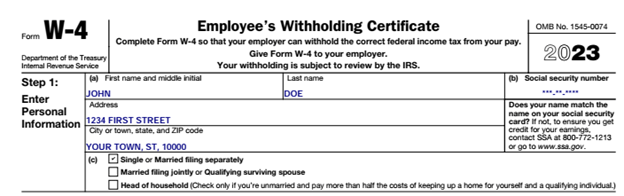
The following example shows how a single person with no dependents might fill out a new W4.

Step 1 is complete, and the single box has been checked off.

We’re going to skip steps 2 and 3, and complete Step 4.

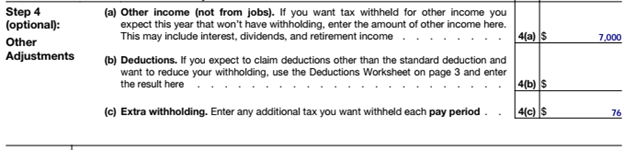
This individual estimates that he will make $7,000 through his side gig, so he includes that amount on line 4(a). Payroll will add this amount to his earnings when calculating withholdings.

He ignores line 4(b) and completes line 4(c). The $7,000 side gig will be subject to the Self-Employment Tax. Extra withholding is meant to take care of that.

In this example, 7,000 is multiplied by 14.13% (SE Tax). The SE Tax on those $7,000 is roughly $989. Let’s assume John is halfway through the year and only has 13 more pay periods left. We divide 989 by 13 and get 76.

John is going to have an extra $76 withheld from his paychecks.

Although basic, this example is meant to take away the mystery out of Form W4 and give you more control over your tax planning.