You’re Going To Want To Keep Track Of Those Miles

If you plan on driving your car for business, in 2023, you might be able to deduct 65.5 cents per mile. If you drive for medical reasons the rate is 22 cents per mile. For charity, it’s 14 cents per mile.

Driving the same car for business and personal use will require you to calculate the use percentage for each. The miles driven for business are deductible, but the miles driven for personal use are not.

Business Miles

There are two methods of deducting the use of your car for business. There is the standard mileage rate (65.5 cents per mile), and there is actual use.

Standard mileage covers maintenance and repairs on your car, as well as gasoline and insurance. The 65.5 cent rate is a flat rate meant to cover all these expenses. You’ll have calculate which method will give you the biggest deduction.  

You can alternate between methods every year, but only if you opted to use the standard mileage rate the first year you used your car for business.

Medical Miles

Although medical miles have a lower rate than business miles, they follow the same rules. You can either deduct the standard mileage rate (22 cents per mile) or actual expenses. Unlike business miles, which are deducted on Schedule C, medical miles can only be deducted on Schedule A, Itemized Deductions.

To figure out which medical expenses are allowed by the IRS consult Publication 502, Medical and Dental Expenses.

Charity Miles

If you used your car to provide services to a qualified charitable organization, you can either deduct mileage (14 cents per mile) or actual expenses. These expenses must be unreimbursed and out-of-pocket.

Like medical deductions, charitable deductions must also be claimed on Schedule A.

Final Note

Burden of proof lies with the taxpayer. Any car deductions claimed on the tax return must be ready to be substantiated in the case of an audit.

Miles driven, and the purpose of those miles, must be made clear to the IRS through recordkeeping.

5 Things to Know About the Retirement Saver’s Credit

1. You’re allowed to claim the saver’s credit and take the IRA deduction on your tax return.

The Retirement Saver’s Credit is a credit available to those who’ve made contributions to their traditional or Roth IRA, as well as to employer-sponsored retirement plans. The credit is an offset on your income tax.

An IRA deduction is an adjustment to your income. It lowers your taxable income, resulting in a lesser tax.

2. You need to meet 3 requirements to claim the saver’s credit.

     1. Be older than 18.

     2. Can’t be claimed as a dependent by anyone.

     3. Can’t be a student.

3. You can’t claim the credit if your contribution was the result of a rollover from one plan to another.

4. The credit will only apply to a maximum contribution amount of $2,000 ($4,000 for married filing jointly).

For example, if you’re single and contribute $3,500 to your retirement plan, only $2,000 will count towards the credit.

5. The amount of the credit has AGI limits.

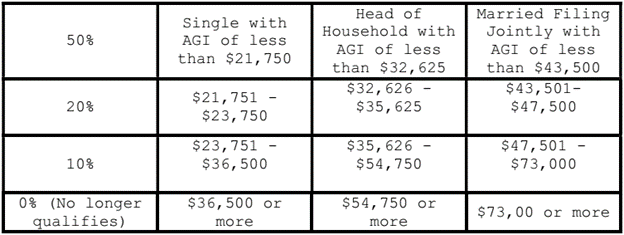
Depending on your adjusted gross income (line 11 on Form 1040), your credit will be capped at 50%, 20%, or 10% of your contribution amount.

The following table shows the limits for 2023.

Using the previous example, if you’re single and made a $3,500 contribution only $2,000 qualifies for the credit. And if your AGI was $19,000 you’re due a credit of $1,000 (50% of contribution amount).

For more information visit the IRS’s retirement page.

The Simplest Way to Deduct Your Home Office

There are two ways to deduct the use of a home office. You can deduct actual expenses, which provide for a higher allowable deduction. If you go this route, you’ll be bound by stricter requirements and more detailed reporting.

The IRS also allows taxpayers to use the Simplified Method. This method allows a deduction of $5 per square foot (limited to an area of 300 square feet).

The deduction is not allowed if a taxpayer has business expenses, unrelated to the use of a home office, that are greater than the gross income produced by the use of your home office.

If your business gross income is greater than your other business expenses, deduct the smaller of this difference or of the home office deduction.

Taxpayers who only had a home office for part of the year are limited to the average monthly square footage use. For example, if you started operating out of your home office in September, you’ll figure the average like this (assuming your home office use was 200 square feet):

((0+0+0+0+0+0+0+0+200+200+200+200)/12)=67 square feet

You home office deduction will be $335 ($5×67).

The simplified method is particularly helpful for self-employed individuals who rent. It’s easier to figure out and requires less recordkeeping. If you’re interested in deducting actual home office expenses, you can read more about Form 8829.

Deducting Mortgage Interest on a Duplex Rental

If you purchased a duplex so that you can live in one unit and rent out the other, you’ll have to calculate how much of the mortgage interest belongs to the rental unit, and how much to the personal unit.

When it comes to any property that is used for both personal and rental purposes, the IRS allows for any “reasonable” method of calculation. For single family properties, you can either divide the number of rooms being rented by the total number of rooms in the house, or you can divide the square footage rented by the total square footage of the property.

For duplexes, the calculation boils down to the size of the units. If both personal and rental units are of similar size, it’s reasonable to split the mortgage interest and real estate taxes in half. If there is a considerable difference in size, perhaps the square footage method might work best. Mortgage interest allocated to the rental unit can be deducted on Schedule E, line 12. Mortgage interest belonging to the unit used for personal use can be deducted on Schedule A, line 8a. (“Should You Save Your Receipts” offers more information on itemized deductions.)

Claiming A Parent On Your Tax Return

There are three ways in which claiming a parent can benefit your tax return, provided you meet a few requirements.

Regardless of your filing status you can claim a parent as a dependent as long as that parent is not filing a joint return with someone else. The only exception is if that parent is only filing a return to receive a refund from taxes withheld. That parent must be a U.S. Citizen, U.S. National, U.S. Resident or a resident of either Canada or Mexico (with either a Social Security Number or ITIN).

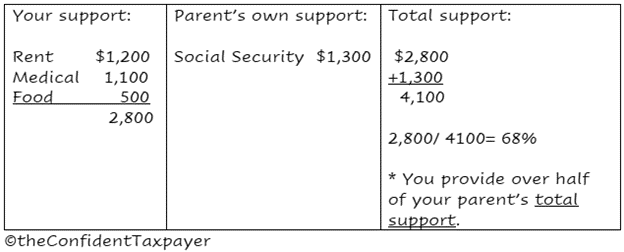
Your mom or dad must have under $4,400 in taxable income for the year. If their only income comes from Social Security none of that income is taxable. More than half of your parent’s total support must come from you. The following example shows how to calculate for such support.

If you’re unmarried or considered unmarried and provided over half of your parent’s support, then you qualify as Head of Household. Filing as Head of Household earns you a higher standard deduction, which helps lower taxable income. Your parent does not have to live with you to qualify you for Head of Household.

Aside from being able to claim your parent as a dependent, and qualifying as Head of Household, you might be able to claim the Credit for Other Dependents for a maximum of $500 per parent. This credit is nonrefundable. It will only lower your tax by the amount of the credit. For example, if your tax on line 16 of your 1040 is $900 and you’re only claiming one parent and qualify for the full $500 credit, your tax will come down to $400.

The Credit for Other Dependents is reduced for those filing a joint return if their AGI is over $400,000; and for all other filers whose AGI is over $200,000. In order to qualify for the credit your parent must be a U.S. Citizen, U.S. Resident, or U.S. National- only.

Can You Deduct Gambling Losses?

Gambling winnings are reported on Form W-2G. Depending on the game, you’ll get it once you pass the winning threshold.

The chart below shows the minimum you must win to trigger a W-2G form from the following games.

It’s possible this additional income will lower your refund or increase a tax liability. This leads to the question: Can I deduct any gambling losses?

Taxpayers are allowed to deduct gambling losses up to their winnings. Meaning that if someone has winnings of $5,000, they can deduct losses up to $5,000 only.

Not everyone is able to claim losses, however. Losses are reported on Schedule A, the form used to claim itemized deductions.

Itemized deductions include mortgage interest, medical expenses, charitable contributions, certain personal taxes.

By default, most tax preparation software will give you the highest of either standard deduction or itemized deduction. So, if your itemized deductions are not more than your standard deduction the software will give you the standard deduction.

If you have enough itemized deductions to file Schedule A and decide to deduct your gambling losses, you have to keep accurate records of both winnings and losses.

The IRS suggests keeping a diary of winnings and losses. As well as keeping copies of records issued by the gambling establishments.

The diary should contain the following information:

  • The date and name of wager played.
  • The name and address of the gambling establishment.
  • Amounts won and lost.
  • Names of persons with you at the time of your wager.

The following IRS publications offer more information on the topics discussed above.

https://www.irs.gov/publications/p529

What To Know About Deducting Business Miles

If you’ve started a business (or side gig), and use your car, you may be able to deduct the miles driven. If you use your car for both business and non-business purposes, you can only deduct the miles driven for business purposes.

Business miles are considered miles driven from your main place of business to other work locations. For example, if you rent an office and have to visit a client, you’re allowed to deduct the miles driven from your office to your client and back to your office. Miles driven from your home to your office are not deductible. These are considered commuting miles.

If you operate your business from your home, however, and visit clients, you’re allowed to deduct miles driven from your home to your clients.

You’re allowed to deduct business miles (also called the Standard Mileage Rate) if you choose this method the first year your car is available for business use. Meaning that you must use this method the first year you claim your car on your tax return.

You must also own or lease your car in order to use the SMR.

The following situations disallow the use of business miles:

  • Using 5 or more cars at the same time (as in fleet operations).
  • If you claimed a depreciation deduction for the car using any other method than the straight-line method.
  • If you claimed a Section 179 deduction on the car.
  • If you claimed the special depreciation allowance on the car.

If any of the previous situations apply, you must deduct actual expenses.

The burden of proof is always on the taxpayer, which makes mileage logs extremely important when it comes time to substantiate deductions taken.

A mileage log should include the following:

-Date and time of the business trip.

-Purpose of the trip.

-Miles driven on that trip.

Mileage can be tracked on spreadsheets, notebooks, apps, or any method the taxpayer chooses.

Is Alimony Deductible?

Alimony or separate maintenance payments are only deductible if executed under a divorce or separation instrument before 2019. Payments executed after 2018 are not deductible by the payer, nor are they taxable to the recipient. It’s possible for divorce or separation instruments executed before 2019 to be later modified to state that alimony is no longer deductible by the payer or taxable to the recipient.

For those allowed to deduct alimony payments, they can do so on Schedule 1, line 19a.

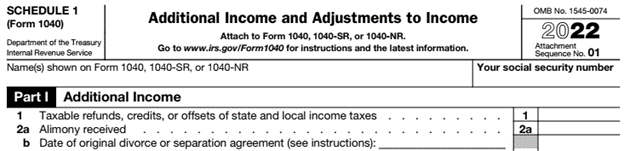
For those having to report alimony payments received, they do so on Schedule 1, line 2a.

Both payer and recipient must include the social security numbers of their spouse or former spouse. If a taxpayer pays alimony to multiple individuals, the social security numbers of all individuals must be included. The same goes for a recipient receiving alimony from more than one individual.