When The Children Grow Up- How To Adjust For Taxes

If you were used to receiving a refund because you claimed your children but can no longer claim them, the transition can be rough. The shock is common for parents, the first year they file without dependents. Refunds are considerably lower, or worse, there’s now a tax liability.

What to do?

If you’re paid wages or salary the easiest solution, from a tax point, is to update your W4. If you previously filed as head of household, and marked that status on your W4, you’ll want to go back and mark “single”.

If you’re self-employed and can no longer claim dependents the only solution available is to make estimated payments. These are quarterly payments that are meant to cover both your income tax and self-employment tax.

Estimated Payments

Taxpayers who expect to owe at least $1,000 on their tax return, and who are unable to have tax withheld, must make quarterly payments the year prior.

A good starting point is last year’s tax return. Your 1040 will show your gross income and expenses. If you expect your income and expenses to be similar, then your self-employment tax will also be similar. If you’re now filing single, instead of head of household, your income tax will be different, most likely higher.

Form 1040-ES offers worksheets that can help calculate accurate payments.

Tax Planning

Although you may still support your adult children, if they’ve fallen out of dependency eligibility for tax purposes, you’ll have to plan for a new tax scenario. Tax planning can be confusing, but hopefully this guide offers a good start for you.


Did You Claim The Employee Retention Credit? You Might Receive A Letter From The IRS.

The Employee Retention Credit came about as a result of mandatory shutdowns during the Covid pandemic. It was a credit meant to help businesses who at the time had paid employees, but who were forced to shut down. The ERC covered the periods after March 19, 2020 and before January 1, 2022. For a complete eligibility list go here.  

In December of 2023 the IRS started looking into possible fraudulent claims of the credit. While businesses that claimed the credit without being eligible may face interest and penalty charges, the IRS acknowledges that many businesses claimed the credit as a consequence of “aggressive marketing” by promoters looking to benefit from businesses claiming the credit. As a result, the IRS is allowing businesses to withdraw from claiming the credit if they haven’t received payment or if they’ve received a check but haven’t cashed it yet. If this is your case, you can go here to start the withdrawal process. For those who have received payments, the IRS plans to release a voluntary disclosure program.

At the moment the IRS’s main concern is businesses who claimed the credit, but which did not exist during the eligibility periods, and those that did not have any paid employees. According to the IRS, the number of businesses set to receive disallowance letters is around 20,000.

If you were persuaded to claim the credit but aren’t sure if you were eligible to claim it, review the eligibility list. If you don’t qualify for the credit and haven’t received payment, or if you received a check but haven’t cashed it, consider starting the withdrawal process. The IRS assures claimants that the tax agency will act if the credit was never claimed.

Filing a Deceased Parent’s Tax Return

If you’re the personal representative of a parent who has passed away, you’ll be tasked with filing their final tax return.

The first step is to gather all their tax documents. These include documents showing income and those supporting tax deductions. It’s important to know what year your parent’s final tax return is actually due. For example, if your parent passed away November 2022, their final tax return is due April 2023. If, however, your parent passed away March 2023, and did not file for 2022, you’ll need to file tax returns for both 2022 and 2023.

If your parent’s tax return shows a tax due, you’ll be responsible for paying it. If it shows a refund, you’ll need to attach Form 1310, Statement of Person Claiming Refund Due a Deceased Taxpayer. The IRS doesn’t require a death certificate, but advices you have one for your records.

When filing the tax return, you must write at the top of the return, “DECEASED”, followed by the person’s name and date of death. If filing electronically, the software should offer a line for this information in the personal data section. The representative’s name and address go in the address section. To sign the return, write “personal representative” on the line.  

The above applies to all tax returns needing to be filed by representatives. Some returns, however, are more complicated than others, and might require extensive professional help. Consult a tax professional if your parent had sources of income beyond jobs and/or pensions.

What Happens When You Don’t File A Tax Return?

For many, filing a tax return is a requirement. It all boils down to a person’s filing status, age, and income.

So, what happens if you’re required to file but don’t?

If you’re due a refund you have three years to file in order to claim it. You’ll still be required to file your return; however, if you file after the three-year limit, you will no longer be eligible to receive that refund.

If you owe taxes and fail to file, the consequences can be more severe. The U.S. tax system is a pay-as-you-go system. We’re expected to pay our taxes as we earn our income, either through withholding or estimated payments. Every day we don’t file or pay our taxes past the tax deadline, penalties and interest accrue on that amount owed. We’re allowed to request an extension to file by October, but there is no extension for paying.

Section 6651(a)(1) of the Tax Code allows for a 5% “Failure to File Penalty” every month it isn’t filed. Section 6651(a)(2) allows for a “Failure to Pay Penalty” of .5% every month the tax isn’t paid. As of the 2nd Quarter of 2023, interest was kept at 7% for individuals (compounded daily).

It’s possible for the IRS to file a “substitute” return on your behalf. The IRS files such return using third-party reports such as W2s, 1099s, and any other tax documents submitted to them. You may lose out on credits and deductions if a substitute return is filed for you, potentially increasing your tax liability.

For those delaying filing a tax return because they owe, the IRS suggests filing anyway and requesting to be put on a payment plan. You can apply for a payment plan online or by calling the IRS at 800-829-1040.

Should You Be Making Estimated Tax Payments?

The US tax system is a pay-as-you-go system. Meaning that you must pay taxes as you earn income.

There are two ways of paying taxes. You can pay either through withholdings or by making estimated payments.

Individuals employed by others fill out Form W-4 to indicate how much should be withheld from their paychecks. Freelance individuals, however, are solely responsible for making those tax payments. They do this through estimated tax payments.

Should you be making estimated payments?

If you have decided to earn extra income on the side through one of the many gigs available, you might have to.

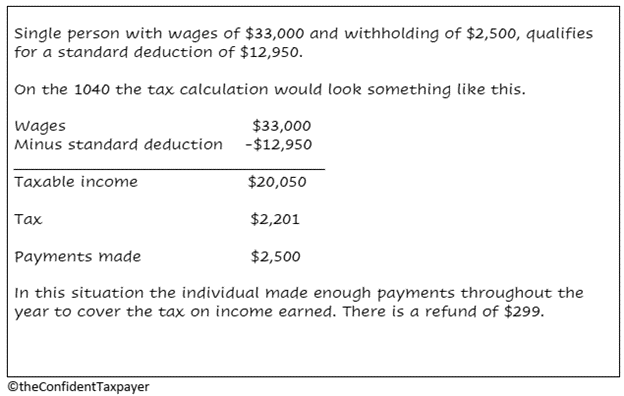
The following is a hypothetical tax scenario for a single person with one W2. The numbers used for wages and withholding are made up to simplify the tax calculation.

In this example the individual had enough withheld and will receive a refund. In a different example, however, this individual earned extra income through ridesharing.

In this second scenario estimated payments would have prevented a tax liability at tax filing time.

So how do you make estimated payments?

The first step is to estimate how much you will earn in the year. This will help you estimate the tax you will owe. Once you have this information you can break the estimated tax into four payments. Each payment has its due date.

Typically, the first payment is due April; second payment is due in June; third payment is due September; the fourth payment is due in January and can be paid along with the tax return.

Form 1040-ES provides worksheets to help calculate estimated taxes. The form also provides payment options accepted by the IRS.

https://www.irs.gov/forms-pubs/about-form-1040-es

How To Withhold More From Your Job To Pay Your Side Gig Tax.

Starting a new job means filling out a new Form W4. It’s easy to forget about that form if you stay at the same job longer than a year. It’s important to know that you can always go back and update your W4 whenever a change happens.

A change, for example, is signing up for a side gig that will report your earnings on a 1099. A side gig such as Uber or Doordash. In a situation like this, you’ll be solely responsible for paying your taxes directly to the IRS. This is a burden freelance workers must deal with.

Freelance workers are responsible for making quarterly payments to the IRS to cover their income tax and self-employment tax.

Another way to pay that tax is to increase your withholding at your current job. A common reaction to this advice is, “But they already take so much!” True, but the reality is, if your income is expected to increase so will your tax. You’ll owe that tax, whether you pay it now or later. The best course of action is to take control now.

One way to take control is to fill out a new Form W4, so that payroll can withhold enough to cover your side gig. You’ll need to include the expected freelance income and self-employment tax on the form.

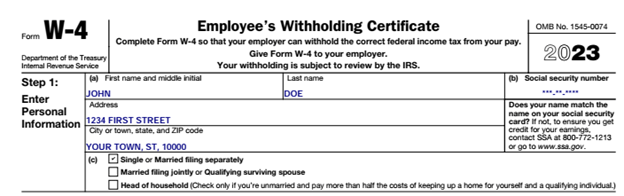
The following example shows how a single person with no dependents might fill out a new W4.

Step 1 is complete, and the single box has been checked off.

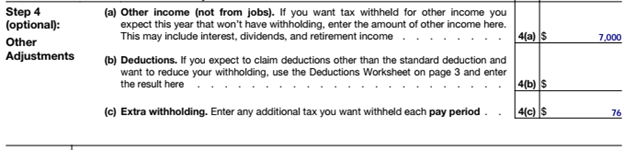
We’re going to skip steps 2 and 3, and complete Step 4.

This individual estimates that he will make $7,000 through his side gig, so he includes that amount on line 4(a). Payroll will add this amount to his earnings when calculating withholdings.

He ignores line 4(b) and completes line 4(c). The $7,000 side gig will be subject to the Self-Employment Tax. Extra withholding is meant to take care of that.

In this example, 7,000 is multiplied by 14.13% (SE Tax). The SE Tax on those $7,000 is roughly $989. Let’s assume John is halfway through the year and only has 13 more pay periods left. We divide 989 by 13 and get 76.

John is going to have an extra $76 withheld from his paychecks.

Although basic, this example is meant to take away the mystery out of Form W4 and give you more control over your tax planning.

Are You An Employee or Independent Contractor?

Willfully or through mistake, an employer can categorize an employee as an independent contractor. There are tax implications that result from this. To prevent this error, find out what makes an employee. If you’ve been miscategorized, there’s a few things you can do to stop this from happening again.

There are 3 main factors that determine the category a person falls in at work. Keep in mind these factors are not black and white. The thing to look for is which category these factors lean towards the most.

  1. Behavioral control: an employee’s work is to a great extent controlled by the company. As opposed to an independent contractor who’s in charge of the work process.
  2. Financial control: if you’re an independent contractor you’re in charge of providing your own supplies and resources to get the job done. If you’re an employee your company should provide what you need.
  3. Relationship: the most important aspect of employer-worker relationships is the permanency of the relationship. Is the worker expected to continue working for the company after a specific project is over? Contracts also factor in; however, a contract may classify a worker as an independent contractor even though every other factor points to employee status.

Consequence of being miscategorized:

Of the two, employees tend to be put in the wrong category the most. Employers might do so out of ignorance or a desire to avoid payroll taxes. Aside from missing out on timely tax payments, employees also miss out on certain benefits like overtime and vacation days.

Things to look out for:

Most companies hire payroll companies to handle employee paychecks. There are employers who choose to do their own payroll. Regardless of who handles payroll each check should have a breakdown that includes gross pay, employee taxes, and net pay.

What to do if you’ve been miscategorized:

  1. Speak with your employer so that the issue can be corrected.
  2. If employer disagrees on status, you can file Form SS-8 with the IRS. The IRS will review the issue then decide.
  3. If the issue isn’t resolved, you can always contact your state’s labor department. In California, the Labor Commissioner’s Office oversees wage disputes.

If you start a job and are given form W-9 but suspect that it should be form W-4, discuss your doubts with your employer. It’s possible the employer isn’t aware of the mistake.