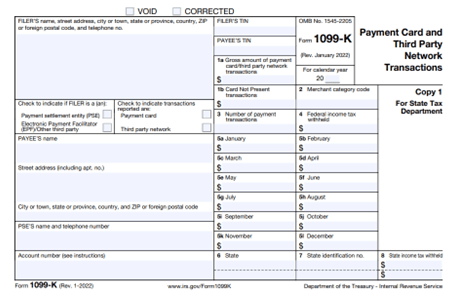
What Exactly Does A 1099-K Report?

If you’ve started your first business or side hustle, you should know the two payment transactions that will produce a 1099-K.

There are two ways of getting paid when you’re doing business online.

1. Card payments.

This is done through payment service companies. Square is one example of these companies. It is also a more direct way of getting paid by a customer.

2. Third-party networks.

Platforms, like eBay and Fiverr, that allow you to sell through them are third-party networks. Although you may interact directly with a customer, when you get paid it goes through the platform first.

Reporting requirements:

Payment service companies have no minimum reporting thresholds. This means that if you get paid $5 through them it’ll get reported and you’ll get a 1099-K form.

Third-party networks have a minimum reporting threshold of $600. They will produce a report once you earn more than that amount.

What to do with a 1099-K:

Amounts shown on this form are reported on line 1 of Schedule C.

If you run more than one business or side hustle in different industries, you’ll have to report 1099-K amounts on each respective Schedule C.

For example: if you sell video editing services on Fiverr, you have to file a Schedule C for that service. If you also do Uber on the side, that will require another Schedule C. So, the 1099-K form you receive from Fiverr will go on the Schedule C for that service; the 1099-K from Uber will go on your ridesharing Schedule C.

Fees:

Any fees charged to you by the company issuing you the 1099-K are not included in the form. To deduct those, you will have to report those on line 10 of Schedule C. Form 1099-K is a straightforward form. It reports the monthly amounts of either card payments or selling revenue you’ve received in the course of your business or side hustle for the year. Amounts reported go on the Schedule C, where you can also include any qualifying deduction you incurred while earning that money. 
U.S. SAVINGS BOND INTEREST

Series EE and Series I bonds are a considerably safe way to start investing. When you purchase a U.S. Savings Bond, you’re lending money to the U.S. government and the government becomes obligated to pay you back plus interest.

The IRS allows taxpayers two ways to report the interest. You can either report all the interest at once the year you cash in your bond, or you can report the interest every year. If you purchase both Series EE and Series I bonds, the method you use to report interest for one will apply to both types of bonds. You’re allowed to start paying interest every year if you had initially opted for paying all at once the year your bond is cashed. You’ll need permission from the IRS, however, if you wish to switch from paying interest every year to paying it all at once.

Typically, the person who purchases the bond is the person who must report and pay tax on interest earned. This is so even if the bond is registered to co-owners. If both co-owners purchased the bond, then interest is taxable to both owners. In cases when a bond is purchased for a child and is registered only in the name of the child, then interest is taxable to the child.

For those who choose to report interest the year of redemption, you’ll receive Form 1099-INT if interest is more than $10. Those who choose to report interest each year will also receive Form 1099-INT, however, an adjustment might have to be made on the return if paper bonds were purchased. This is because the Treasury method for processing paper bonds is not as efficient as it is for electronic bonds.

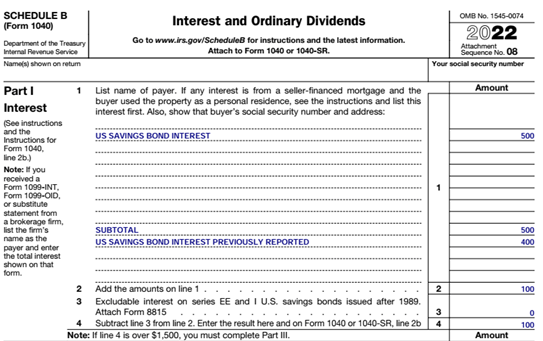
Adjustments are made on Schedule B. The following example shows how to make such an adjustment.

For more information on Series EE and Series I bonds, visit the Treasury Direct site.

Business Travel Expense Write-Offs

If you’re a business owner, you can deduct travel expenses you paid for yourself and your employees. Travel expenses must be for temporary travel away from your main place of business.

Temporary travel can be anything from one day to less than a year. In fact, it doesn’t even have to last an entire day, as long as the trip requires sleep or rest due to the demands of the work performed away from home.

“Home” is defined by the IRS as your “Tax Home” or in other words, your main place of business. If you have an office, that is your tax home. For those who work from home, your home office qualifies as your tax home. The three most important factors to consider in determining your tax home are:

1. Where you spend the most time while conducting work.

2. Where you get the most work done.

3. Where the most significant amount of income is produced.

If you operate from multiple locations these three factors will help you decide where your tax home is.

The IRS does not consider business travel going from where you live to your tax home. That is considered commuting. Cost of meals while at your tax home are also non-deductible.

Business travel expenses must be ordinary and necessary. The IRS cautions against deducting “lavish” expenses or any costs arising from personal use.

Deductible business travel expenses include: transportation (even if you used your own car) you have to take from your tax home to your business destination; meals and lodging; dry cleaning and laundry; any fares you had to pay to get from the airport to your hotel and from your hotel to your business destination. For a full list refer to Publication 463 by the IRS.

As with any deduction, burden of proof belongs to the taxpayer and records must be kept of all expenses paid for.

Can You Deduct Gambling Losses?

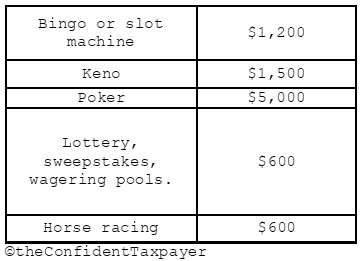
Gambling winnings are reported on Form W-2G. Depending on the game, you’ll get it once you pass the winning threshold.

The chart below shows the minimum you must win to trigger a W-2G form from the following games.

It’s possible this additional income will lower your refund or increase a tax liability. This leads to the question: Can I deduct any gambling losses?

Taxpayers are allowed to deduct gambling losses up to their winnings. Meaning that if someone has winnings of $5,000, they can deduct losses up to $5,000 only.

Not everyone is able to claim losses, however. Losses are reported on Schedule A, the form used to claim itemized deductions.

Itemized deductions include mortgage interest, medical expenses, charitable contributions, certain personal taxes.

By default, most tax preparation software will give you the highest of either standard deduction or itemized deduction. So, if your itemized deductions are not more than your standard deduction the software will give you the standard deduction.

If you have enough itemized deductions to file Schedule A and decide to deduct your gambling losses, you have to keep accurate records of both winnings and losses.

The IRS suggests keeping a diary of winnings and losses. As well as keeping copies of records issued by the gambling establishments.

The diary should contain the following information:

  • The date and name of wager played.
  • The name and address of the gambling establishment.
  • Amounts won and lost.
  • Names of persons with you at the time of your wager.

The following IRS publications offer more information on the topics discussed above.

https://www.irs.gov/publications/p529

Is Alimony Deductible?

Alimony or separate maintenance payments are only deductible if executed under a divorce or separation instrument before 2019. Payments executed after 2018 are not deductible by the payer, nor are they taxable to the recipient. It’s possible for divorce or separation instruments executed before 2019 to be later modified to state that alimony is no longer deductible by the payer or taxable to the recipient.

For those allowed to deduct alimony payments, they can do so on Schedule 1, line 19a.

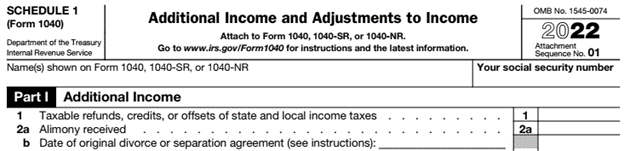
For those having to report alimony payments received, they do so on Schedule 1, line 2a.

Both payer and recipient must include the social security numbers of their spouse or former spouse. If a taxpayer pays alimony to multiple individuals, the social security numbers of all individuals must be included. The same goes for a recipient receiving alimony from more than one individual.

Early Retirement Distribution Penalty- Explaining The Medical Exemption

A retirement distribution is considered early when it is distributed before the taxpayer turns 59 ½. In this case there is no 10% tax penalty attached to this distribution.

If a distribution is taken before turning 59 ½, not only is the amount taxable but there is an additional 10% tax penalty. The 10 percent penalty is calculated as 10 percent of the distribution. So, if you take out $5,000 from your 401K before turning 59 ½, you will have to include that amount to your other taxable income, as well as pay an additional $500 as penalty.

There is a list of exemptions that release taxpayers from that 10% penalty. One of those exemptions is the medical exemption, which is the subject of this post.

The 10% penalty is not imposed on taxpayers if early retirement distributions were used to pay for qualified medical expenses of the taxpayer, spouse, or dependent. Such medical expenses must not have been reimbursed at any point.

According to the Internal Revenue Code (72(t)2(B)), distributions must “not exceed the amount allowable as a deduction under section 213 to the employee for amounts paid during the taxable year for medical care (determined without regard to whether the employee itemizes deductions for such taxable year).”

Section 213 is the section that tells us that we can only itemize the medical expenses that exceed 7.5% of our adjusted gross income. For example, a taxpayer with an AGI of $45,000 can only itemize medical expenses in excess of $3,375.

As 72(t)2(B) states though, a taxpayer doesn’t have to itemize to qualify for the medical exemption to the early distribution penalty.

Using our previous example, let’s assume the taxpayer with an AGI of $45,000 had medical expenses of $7,000 (and did not itemize). According to section 213, she can only claim $3,625 in medical expenses ($7,000-$3,375).

In order to qualify for the medical exemption, her distribution must not have been more than $3,625.

As with any other claim on the 1040, burden of proof lies with the taxpayer. Records must be kept for every medical expense that qualifies you for the exemption.