Canceled, Discounted, Or Modified Credit Card Debt

If you owe credit card debt and the lender decides to cancel (“discharge”) your remaining balance, or discount or modify the principal balance, you’ll likely receive Form 1099-C, Cancellation of Debt. The amount shown on box 2 is taxable as ordinary income, meaning it will not be subject to any extra tax besides the regular income tax.

It’s possible, however, to make some or all the canceled debt nontaxable. The IRS offers “exceptions” and “exclusions” to the rule, with exceptions considered first before exclusions.

For credit card borrowers, canceled debt might be nontaxable if the debt could have been deductible. If you were self-employed, and the credit card was used solely for business expenses, that debt could have been deductible and therefore the canceled debt would be nontaxable.

If your canceled debt does not qualify for an exception, you may still be able to exclude canceled debt from income if the debt was canceled due to a title 11 bankruptcy case. One other possible exclusion is insolvency. This exclusion can be trickier, and the services of a tax pro might be required.

Under the insolvency exclusion, your total debt, immediately before your debt was canceled, must have been more than your total assets. The IRS provides an insolvency worksheet in Publication 4681 that can help you figure out if you were insolvent immediately before your credit card debt was canceled, discounted, or modified. Publication 4681 also provides a full list of exceptions and exclusions, as well as examples that might be relevant.

If you qualify for an exclusion, it will have to be reported on Form 982, with the appropriate box checked.

If you do not qualify for any exception or exclusion your canceled debt will have to be included in income. There are two ways to plan for a possible increase in tax. You can either make an estimated payment throughout the year or increase your withholding at work.


3 Things to Know About Capital Losses

1. A loss can only be claimed on a tax return for investment assets, not for personal assets. Personal assets are assets such as a home or car. Gains from personal assets are still taxed, but losses cannot be claimed (although an exclusion is available for the sale of a home).

2. Capital losses reduce income. Capital losses are claimed on line 7 of Form 1040 (in parentheses). They lower your income, which in turn can produce a lower tax.

3. Capital losses are limited to the lesser of $3,000 or your total net loss. To figure your capital losses you’ll first need to list your sales on Form 8949, then transfer your short-term and long-term net gains/losses to Schedule D, where you’ll figure your limit and any possible carryover losses.

What To Do with the 1099-K You Get from Venmo

If you’re one of the many people who use payment apps like Venmo and Zelle, you’ve probably heard that companies will begin reporting amounts to the IRS. There’s a lot of confusion about the new change but this article should clear most it.

Companies that use third-party payment networks have always been required to report amounts received to the IRS. The former threshold was $20,000 but the IRS brought it down to $600 in recent years. (Check out this article for more information.)

The IRS is focused on making compliant individuals and companies who fail to report income earned from business activity. Although the IRS has clarified what constitutes taxable and non-taxable, that still won’t make it easy on individuals who use payment apps for personal use and still receive Form 1099-K.

So here it goes. Amounts received through payment apps that were personal (such as gifts and reimbursements) will either have to be corrected by the company issuing the form or will have to be adjusted on your tax return.

The IRS advises taxpayers to call the issuing company (their info should be on the 1099-K) and have them correct the amount reported. If, for whatever reason, that can’t be done, you can make the correction on your tax return.

Note: Keep your original 1099-K and all copies of your communication efforts with the issuing company.

To make the correction on your tax return you’ll have to report the amount received on Schedule 1, line 8z. Then, report the same amount on the same schedule, on line 24z. This will fulfill the reporting requirement while also zeroing out the income.

Hopefully this article clarified the biggest confusion about Form 1099-K. If you have other questions the IRS has set up an FAQ page to answer questions about this form.

Tax Filing for Spouses Who Run a Business Together

It’s important, when spouses work together, that each spouse gets the social security and Medicare credit they deserve. It’s common for one spouse to file a Schedule C, claiming all income and expenses, when in fact, both spouses contributed equally to running their business.

The IRS generally requires married couples who run unincorporated businesses to file as partnerships. To limit the level of complexity, however, the IRS allows for the Qualified Joint Venture exception. This exception is available to married couples who:

1) file a joint return and are the only members of the venture.

2) materially participate in the business.

3) elect not to be treated as a partnership.

If you and your spouse qualify to file as a Qualified Joint Venture, you can each file a Schedule C. You’ll need to split the income and expenses according to each person’s interest in the business. For example, if both spouses were equally responsible and exerted the same level of control in the business it’s safe for each spouse to report 50% of the income and expenses on their respective Schedule Cs. You won’t necessarily pay more in taxes, but you will make sure each person’s social security and Medicare accounts are credited.

Note that the business must be co-owned by both spouses and must not be a state law entity. If you’ve registered the business with the state as an LLC, you no longer qualify as a Qualified Joint Venture and must file as a partnership. This involves filing Form 1065, in addition to Form 1040.

Filing a Deceased Parent’s Tax Return

If you’re the personal representative of a parent who has passed away, you’ll be tasked with filing their final tax return.

The first step is to gather all their tax documents. These include documents showing income and those supporting tax deductions. It’s important to know what year your parent’s final tax return is actually due. For example, if your parent passed away November 2022, their final tax return is due April 2023. If, however, your parent passed away March 2023, and did not file for 2022, you’ll need to file tax returns for both 2022 and 2023.

If your parent’s tax return shows a tax due, you’ll be responsible for paying it. If it shows a refund, you’ll need to attach Form 1310, Statement of Person Claiming Refund Due a Deceased Taxpayer. The IRS doesn’t require a death certificate, but advices you have one for your records.

When filing the tax return, you must write at the top of the return, “DECEASED”, followed by the person’s name and date of death. If filing electronically, the software should offer a line for this information in the personal data section. The representative’s name and address go in the address section. To sign the return, write “personal representative” on the line.  

The above applies to all tax returns needing to be filed by representatives. Some returns, however, are more complicated than others, and might require extensive professional help. Consult a tax professional if your parent had sources of income beyond jobs and/or pensions.

Getting Paid in Virtual Currency

If you’re self-employed and are considering virtual currency as a payment method, you’ll be surprised to find that not much will change for you in terms of tax reporting. That being said, there’s still a few details to go over.

First, the IRS classifies virtual currency (or digital assets) as property, not cash. Virtual currency falls in line with other property like stock. So, when you provide a service and get paid with virtual currency, you’re exchanging a service for a property.

As an independent contractor, you’re still obligated to report income over $400 on your Schedule C and to pay self-employment tax on that income. The individual or company that paid you still has to report payments made to you over $600 to the IRS. In this regard nothing has changed.

The only thing that has changed is how you calculate the income you receive. In a regular cash transaction, let’s say you charge $100 for your service, the buyer pays you and you report those $100 straight on your return. If you receive virtual currency, you’ll have to report the Fair Market Value (in US dollars) of that payment. The FMV is what the currency was going for on the market on the day you received it. This makes it important to keep detailed track of your virtual receipts.

It’s possible you might not receive any tax form showing your income in virtual currency. You’ll still have to report it. For a few years now the IRS has added a question at the top of the 1040 asking if you’ve received or sold digital assets. If you got paid in virtual currency, click “Yes”. Although slowly, the IRS is cracking down on taxpayers who might owe taxes because of virtual currency transactions.

Tax Rules for Students Working

Scenario: An 18-year-old college student, who is claimed as a dependent on his parents’ tax return, decides to get a job. He wants to know how this will affect his parents’ return. 

There are three main concerns when a student takes up a job while being claimed on his parents’ tax return.

#1. Can my parents still claim me?

Your parents can still claim you even if you get a job, so long as you’re still under the age of 24 at the end of the year, remain a student, and you don’t provide over half of your support. Technically, you’re supposed to live with your parents, unless the only reason you’re not is because you’re going to school.

#2. Do you have to file a tax return?

Maybe. As a dependent, there are certain filing requirements you must meet to be required to file.

If your income comes solely from a W2 job and you haven’t married, you must have made over $12,550 (for the 2022 tax year). If you made less than this, you might still want to file if a refund is in order. Which leads us to our third concern.

#3. If I file, will I owe?

How much you’ll get back or owe boils down to your standard deduction. As a dependent, your standard deduction is the larger of $1,100 or the income you earned plus $350 (but not more than $12,550).

For example, you got a summer job and made $5,600. Your standard deduction is the larger of $1,100 or $5,600 plus $350. Your standard deduction is $5,950. On a straight-forward return like this, taxable income is 0 and there’s very likely a refund.

Note: It’s important for you and your parents to be on the same page. The best course of action is to consult a tax professional before getting a job to have a higher degree of certainty of what to expect come tax time.

Deducting Mortgage Interest on a Duplex Rental

If you purchased a duplex so that you can live in one unit and rent out the other, you’ll have to calculate how much of the mortgage interest belongs to the rental unit, and how much to the personal unit.

When it comes to any property that is used for both personal and rental purposes, the IRS allows for any “reasonable” method of calculation. For single family properties, you can either divide the number of rooms being rented by the total number of rooms in the house, or you can divide the square footage rented by the total square footage of the property.

For duplexes, the calculation boils down to the size of the units. If both personal and rental units are of similar size, it’s reasonable to split the mortgage interest and real estate taxes in half. If there is a considerable difference in size, perhaps the square footage method might work best. Mortgage interest allocated to the rental unit can be deducted on Schedule E, line 12. Mortgage interest belonging to the unit used for personal use can be deducted on Schedule A, line 8a. (“Should You Save Your Receipts” offers more information on itemized deductions.)

Are Social Security Benefits Taxable?

If your only income comes from social security benefits, generally there’s nothing to report and your benefits are not taxable.

If, however, you have additional income such as wages, pensions, capital gains, dividends, and interest, you will have to figure out how much is taxable, if any.

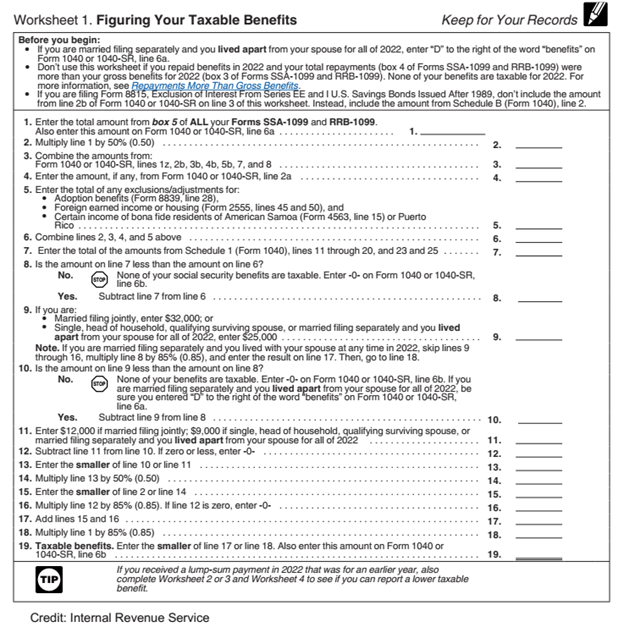
To figure out if any of your benefits are taxable you take 1/2 of your benefits and add it to your additional income. If you’re married and file jointly, you’ll have to combine both incomes. If you’re married and file jointly and your spouse isn’t receiving benefits yet, you’ll still have to combine incomes. If your income is more than your “base amount”, some of your benefits might be taxable.

Base amounts are based on filing status. For 2022 the base amounts were:

Single, head of household, and qualifying surviving spouse have a base amount of $25,000.

Married filing jointly has a base amount of $32,000.

Married filing separately (and lived apart from your spouse) has a base amount of $25,000.

Married filing separately (and lived with spouse) has a base amount of $0.

It’s important to note that even if your benefits are not taxable because you did not go over your base amount, you might still need to file a tax return to report your additional income. To find out how much of your benefits are taxable, if any, you’ll have to fill out Worksheet 1, found in the most current Publication 915 of the IRS.

If part of your benefits is taxable, and you anticipate this to be the case for future years, it’s important to prepare for a tax increase. One way to handle a higher tax is to have tax withheld from your benefits. You’ll need to submit Form W-4V with the Social Security Administration. Another option is to increase withholding on your other sources of income.

Form W9 For Independent Contractors

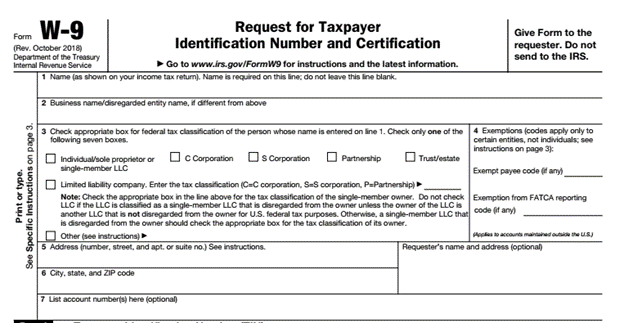
If you’re planning on doing freelance work for a business, either a company or another independent contractor, they might have you fill out Form W9. This is typically the case if they’re expecting to pay you over $600.

The reason they have you fill this form out is because they’ll need your name and TIN (ssn or itin) for them to report your earnings to the IRS. This way, they can deduct what they paid you and have written evidence of that deduction. They send Form 1099-NEC (formerly 1099-MISC), to you and the IRS.

Filling out the form is very straightforward.

Line 1: Your name as it’s registered at the Social Security Administration.

Line 2: If you’ve registered your business under a fictitious business name, that name will go here. If you don’t have a FBN leave it blank.

Line 3: If you’ve never incorporated your business and have not applied for a corporate tax classification, check “Individual/sole proprietor”.

Line 4: Leave this section blank if you’re a sole proprietor (same as independent contractor) since you don’t qualify for any exemption to backup withholding (more on this later).

Line 5-6: Your address. This can be your home address if you operate from home, or your business address if you have an office.

Line 7: You can leave this blank.

Part I: If you have either a social security number or ITIN, write that down here. If you operate under an Employer Identification Number, you can write that instead.

Part II: Read certification, then sign and date if you comply.

Will they take taxes out of your checks?

They shouldn’t. Unlike a W2 job, the business giving you work is not responsible for submitting your taxes to the IRS. You’re solely responsible for paying your own tax.

Check out this post for more information on making estimated tax payments.

There is the matter of “backup withholding”, but this doesn’t apply to independent contractors unless they failed to provide their correct name or TIN.