Did You Claim The Employee Retention Credit? You Might Receive A Letter From The IRS.

The Employee Retention Credit came about as a result of mandatory shutdowns during the Covid pandemic. It was a credit meant to help businesses who at the time had paid employees, but who were forced to shut down. The ERC covered the periods after March 19, 2020 and before January 1, 2022. For a complete eligibility list go here.  

In December of 2023 the IRS started looking into possible fraudulent claims of the credit. While businesses that claimed the credit without being eligible may face interest and penalty charges, the IRS acknowledges that many businesses claimed the credit as a consequence of “aggressive marketing” by promoters looking to benefit from businesses claiming the credit. As a result, the IRS is allowing businesses to withdraw from claiming the credit if they haven’t received payment or if they’ve received a check but haven’t cashed it yet. If this is your case, you can go here to start the withdrawal process. For those who have received payments, the IRS plans to release a voluntary disclosure program.

At the moment the IRS’s main concern is businesses who claimed the credit, but which did not exist during the eligibility periods, and those that did not have any paid employees. According to the IRS, the number of businesses set to receive disallowance letters is around 20,000.

If you were persuaded to claim the credit but aren’t sure if you were eligible to claim it, review the eligibility list. If you don’t qualify for the credit and haven’t received payment, or if you received a check but haven’t cashed it, consider starting the withdrawal process. The IRS assures claimants that the tax agency will act if the credit was never claimed.


Why Self-Employed People Should Always Carry A Weekly Planner

A weekly planner isn’t just great for jotting down appointments. It can also serve as supporting documentation if the IRS were to ever audit your return. The U.S. Tax Court often makes it clear in case decisions that the burden of proof falls on the taxpayer claiming the deductions and credits. In the event of an audit, any unsubstantiated deduction will result in a higher tax bill.

But what should be written down? Even if you use third-party payment companies, such as Square, and pay for every expense with your debit card, it’s still beneficial to write down every sale and major expense to avoid discrepancies.

If you drive to clients’ homes or to any other business destination, it’s important to log in your mileage and destination to prove you are entitled to take the mileage deduction.

In a recent court case, a taxpayer’s mileage claim was disallowed after he was unable to back up his business mileage. Although he had a log of miles driven, he did not make it clear if the miles were for business or personal use. Writing down the purpose of the business trip could prevent a future disallowance.

Aside form helping you prepare an accurate tax return, a weekly planner can also help you manage your customer relationships. If you’re looking for recurring sales, knowing the date of your last visit can show your clients you haven’t forgotten them.

Documents You Need If Your Earned Income Credit Is Audited

If you’re claiming the Earned Income Credit based on a qualifying child, expect more rules than if you were claiming it only for yourself. The IRS claims “an estimated 33% of the credit is paid out in error.”

There are 4 tests your qualifying child must meet before you can claim the credit. If audited each test must be supported by documentation.

1. The relationship test

Your qualifying child must be your son, daughter, stepchild, foster child, or a descendant of these. Your sibling, half sibling, stepsibling, or a descendant of these can also be a qualifying child.

2. The age test

The qualifying child must be under the age of 19 at the end of the tax year and be younger than you. Students under the age of 24 also qualify.

3. The residency test

The qualifying child must have lived with you over half of the year.

4. Joint return test

Your qualifying child cannot file a joint return unless it is only to claim a refund on income tax withheld.

Nothing is more frustrating than a taxpayer who is entitled to the credit but due to personal circumstances isn’t prepared to provide supporting documents when audited. It’s important to know what’s expected to better prepare.

The IRS generally looks for evidence that prove 3 of the 4 tests above are true. It wants you to prove that the child is related to you, lived with you, and is under the qualifying age.

To prove the child lived with you, you’ll need documents that tie both you and the child to the same address. There are situations in which one parent claims the child even though the child lives with the other parent. Typically, the child has the same address as the parent he lives with, posing a challenge to the parent wanting to claim the child.

Proving a qualifying relationship to the child usually means submitting birth certificates. If your qualifying child is your son or daughter this should be an easy task. If you’re a grandparent claiming your grandchild, however, you’ll have extra steps to follow. You’ll not only need the child’s birth certificate but also the child’s parent’s birth certificate to prove their relationship to you.

If the child is under the age of 19 you generally don’t need to submit anything. If the child is under the age of 24, you’ll need to submit proof that the child was a full-time student for any part of five months of the year.

An EIC audit can be a small deal to some, and a big deal to others. The best course of action is to know what’s expected and have everything ready, just in case. In the event that you can’t provide supporting documents the IRS might deny or reduce your EIC for future tax years. For more information consult Publication 596.

Short Guide to Claiming the Used Clean Vehicle Credit

There are several good reasons to buy an electric vehicle. The main reason is the ever-increasing price of gas. It’s expensive going to work. For many who want to start a ride-sharing gig it just makes sense.

For several years now the IRS has offered people a credit for new electric vehicles. A new EV, though, may be out of range for many people’s budgets. For those who are aiming for a used EV, the IRS is now offering a credit to qualifying taxpayers.

To claim the credit, a taxpayer cannot be claimed on another’s return. The taxpayer must not be the original owner, must not have claimed a used clean vehicle credit in the 3 years before the current purchase, and must not have purchased the vehicle for resale.

Additionally, a taxpayer’s AGI must be under $150,000 if married filing jointly, $112,500 for heads of households, and under $75,000 if single or married filing separately.

To find a list of the current qualifying vehicles go to fueleconomy.gov. To qualify for this credit the vehicle must have a sale price of $25,000 or less and must have been purchased from a dealer.

The credit is claimed on Form 8936, for a maximum credit of $4,000. You’ll need the car’s VIN number. The dealer is also responsible for providing the following information:

  • Battery capacity
  • Sale date and sale price
  • Dealer’s name and tax ID

5 Things to Know About the Retirement Saver’s Credit

1. You’re allowed to claim the saver’s credit and take the IRA deduction on your tax return.

The Retirement Saver’s Credit is a credit available to those who’ve made contributions to their traditional or Roth IRA, as well as to employer-sponsored retirement plans. The credit is an offset on your income tax.

An IRA deduction is an adjustment to your income. It lowers your taxable income, resulting in a lesser tax.

2. You need to meet 3 requirements to claim the saver’s credit.

     1. Be older than 18.

     2. Can’t be claimed as a dependent by anyone.

     3. Can’t be a student.

3. You can’t claim the credit if your contribution was the result of a rollover from one plan to another.

4. The credit will only apply to a maximum contribution amount of $2,000 ($4,000 for married filing jointly).

For example, if you’re single and contribute $3,500 to your retirement plan, only $2,000 will count towards the credit.

5. The amount of the credit has AGI limits.

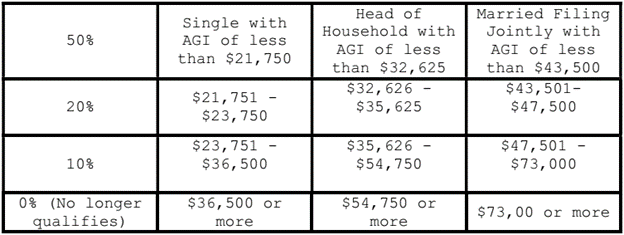
Depending on your adjusted gross income (line 11 on Form 1040), your credit will be capped at 50%, 20%, or 10% of your contribution amount.

The following table shows the limits for 2023.

Using the previous example, if you’re single and made a $3,500 contribution only $2,000 qualifies for the credit. And if your AGI was $19,000 you’re due a credit of $1,000 (50% of contribution amount).

For more information visit the IRS’s retirement page.

The Simplest Way to Deduct Your Home Office

There are two ways to deduct the use of a home office. You can deduct actual expenses, which provide for a higher allowable deduction. If you go this route, you’ll be bound by stricter requirements and more detailed reporting.

The IRS also allows taxpayers to use the Simplified Method. This method allows a deduction of $5 per square foot (limited to an area of 300 square feet).

The deduction is not allowed if a taxpayer has business expenses, unrelated to the use of a home office, that are greater than the gross income produced by the use of your home office.

If your business gross income is greater than your other business expenses, deduct the smaller of this difference or of the home office deduction.

Taxpayers who only had a home office for part of the year are limited to the average monthly square footage use. For example, if you started operating out of your home office in September, you’ll figure the average like this (assuming your home office use was 200 square feet):

((0+0+0+0+0+0+0+0+200+200+200+200)/12)=67 square feet

You home office deduction will be $335 ($5×67).

The simplified method is particularly helpful for self-employed individuals who rent. It’s easier to figure out and requires less recordkeeping. If you’re interested in deducting actual home office expenses, you can read more about Form 8829.

Claiming A Parent On Your Tax Return

There are three ways in which claiming a parent can benefit your tax return, provided you meet a few requirements.

Regardless of your filing status you can claim a parent as a dependent as long as that parent is not filing a joint return with someone else. The only exception is if that parent is only filing a return to receive a refund from taxes withheld. That parent must be a U.S. Citizen, U.S. National, U.S. Resident or a resident of either Canada or Mexico (with either a Social Security Number or ITIN).

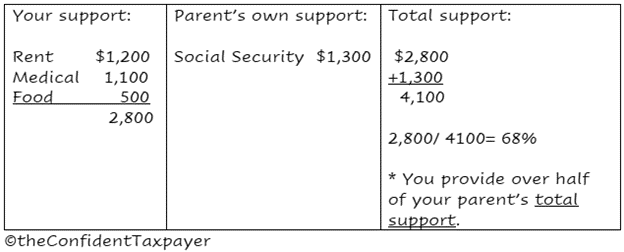
Your mom or dad must have under $4,400 in taxable income for the year. If their only income comes from Social Security none of that income is taxable. More than half of your parent’s total support must come from you. The following example shows how to calculate for such support.

If you’re unmarried or considered unmarried and provided over half of your parent’s support, then you qualify as Head of Household. Filing as Head of Household earns you a higher standard deduction, which helps lower taxable income. Your parent does not have to live with you to qualify you for Head of Household.

Aside from being able to claim your parent as a dependent, and qualifying as Head of Household, you might be able to claim the Credit for Other Dependents for a maximum of $500 per parent. This credit is nonrefundable. It will only lower your tax by the amount of the credit. For example, if your tax on line 16 of your 1040 is $900 and you’re only claiming one parent and qualify for the full $500 credit, your tax will come down to $400.

The Credit for Other Dependents is reduced for those filing a joint return if their AGI is over $400,000; and for all other filers whose AGI is over $200,000. In order to qualify for the credit your parent must be a U.S. Citizen, U.S. Resident, or U.S. National- only.

The American Opportunity Tax Credit

If you, your spouse, or dependent(s) attended postsecondary school and have not completed the first four years, you might be eligible to claim the American Opportunity Credit. This credit is per eligible student. If there are two eligible students on the return, then the credit can be claimed for both students.

The credit must be claimed for expenses paid during the relevant year. For example, you cannot claim the credit on your 2023 tax return if the expenses paid were for an academic period in 2022. The only exception is if expenses paid in 2022 were for an academic period that began in the first 3 months of 2023.

The IRS has four requirements that must be met by the qualifying student.

  1. The student must not have completed the first four years of postsecondary education.
  2. The credit must not have been claimed by you or anyone else for the student for any 4 tax years before the given tax year in which the credit is being claimed.
  3. The student must have been pursuing a degree, certificate, or recognized educational credential; and, must have been enrolled at least part-time as determined by the educational institution.
  4. As of the end of the tax year in which the credit is being claimed, the student must not have been convicted of a federal or state felony for possessing or distributing a controlled substance.

Once it’s been determined that the student and the educational institution are eligible for the credit, it’s time to add up the qualified expenses.

Qualified education expenses include any student activity fee that must be paid to the institution as a condition of enrollment. Books and supplies required for any course, whether paid to the institution or not, are also qualified expenses.

There are two important things to know when claiming this credit.

  1. Form 1098-T is mandatory. This form is issued to the student by the educational institution. So, whether you self-file or go to the a tax preparer, make sure you have access to this form.
  2. The taxpayer bears the burden of proof whenever a credit is claimed. This means that the taxpayer must keep records to substantiate the eligibility of the student and institution, as well as the qualified expenses paid.