Deducting Mortgage Interest on a Duplex Rental

If you purchased a duplex so that you can live in one unit and rent out the other, you’ll have to calculate how much of the mortgage interest belongs to the rental unit, and how much to the personal unit.

When it comes to any property that is used for both personal and rental purposes, the IRS allows for any “reasonable” method of calculation. For single family properties, you can either divide the number of rooms being rented by the total number of rooms in the house, or you can divide the square footage rented by the total square footage of the property.

For duplexes, the calculation boils down to the size of the units. If both personal and rental units are of similar size, it’s reasonable to split the mortgage interest and real estate taxes in half. If there is a considerable difference in size, perhaps the square footage method might work best. Mortgage interest allocated to the rental unit can be deducted on Schedule E, line 12. Mortgage interest belonging to the unit used for personal use can be deducted on Schedule A, line 8a. (“Should You Save Your Receipts” offers more information on itemized deductions.)

Are Social Security Benefits Taxable?

If your only income comes from social security benefits, generally there’s nothing to report and your benefits are not taxable.

If, however, you have additional income such as wages, pensions, capital gains, dividends, and interest, you will have to figure out how much is taxable, if any.

To figure out if any of your benefits are taxable you take 1/2 of your benefits and add it to your additional income. If you’re married and file jointly, you’ll have to combine both incomes. If you’re married and file jointly and your spouse isn’t receiving benefits yet, you’ll still have to combine incomes. If your income is more than your “base amount”, some of your benefits might be taxable.

Base amounts are based on filing status. For 2022 the base amounts were:

Single, head of household, and qualifying surviving spouse have a base amount of $25,000.

Married filing jointly has a base amount of $32,000.

Married filing separately (and lived apart from your spouse) has a base amount of $25,000.

Married filing separately (and lived with spouse) has a base amount of $0.

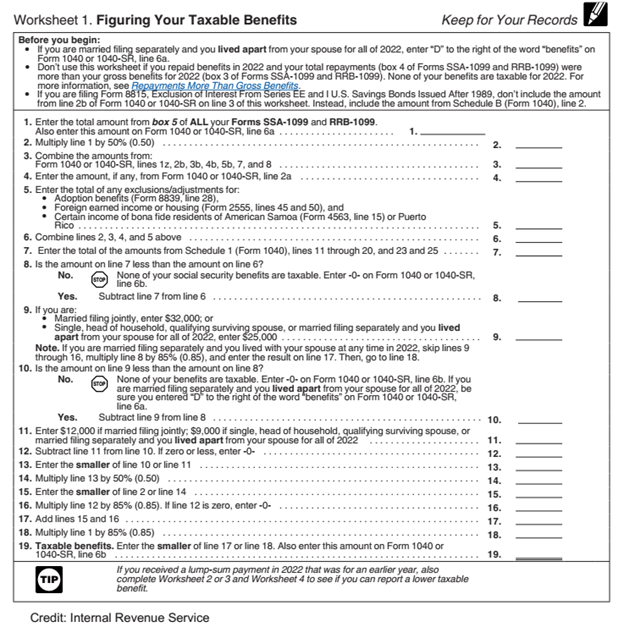
It’s important to note that even if your benefits are not taxable because you did not go over your base amount, you might still need to file a tax return to report your additional income. To find out how much of your benefits are taxable, if any, you’ll have to fill out Worksheet 1, found in the most current Publication 915 of the IRS.

If part of your benefits is taxable, and you anticipate this to be the case for future years, it’s important to prepare for a tax increase. One way to handle a higher tax is to have tax withheld from your benefits. You’ll need to submit Form W-4V with the Social Security Administration. Another option is to increase withholding on your other sources of income.

Should You Save Your Receipts?

Deductions lower your taxable income. The lower your taxable income the lower your tax. The IRS gives you two options to lower your tax. The standard deduction or itemized deductions.

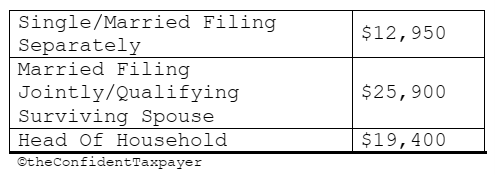
By default, each filing status is given a set amount to deduct. For 2023 those amounts were:

The standard deduction increases each year to adjust for inflation. There is no need to save receipts if you’re using this option.

The second option is to itemize deductions. This option might be beneficial for taxpayer who have qualifying deductions that add up to an amount higher than the standard deduction. In this case, saving receipts is a must.

Qualifying itemized deductions fall under the following categories:

Medical/dental expenses

State and local income taxes

State and local property taxes

Mortgage interest

Charitable contributions

(Visit the IRS for an extensive list of itemized deductions.)

Saving receipts might not be necessary if you think the standard deduction is as much as you’ll qualify for. In many cases, the standard deduction might be higher than all your qualifying itemized deductions tallied up. But even if you don’t need to save receipts, consider keeping track of your expenses for budgeting purposes.

Form W9 For Independent Contractors

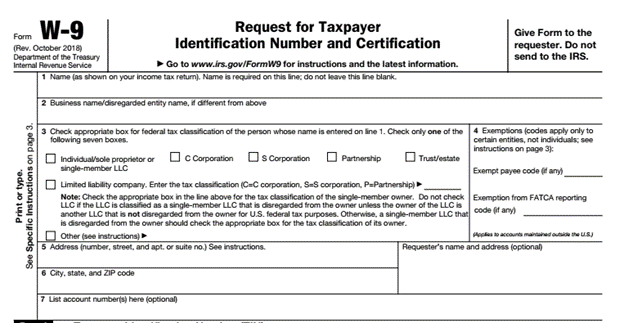
If you’re planning on doing freelance work for a business, either a company or another independent contractor, they might have you fill out Form W9. This is typically the case if they’re expecting to pay you over $600.

The reason they have you fill this form out is because they’ll need your name and TIN (ssn or itin) for them to report your earnings to the IRS. This way, they can deduct what they paid you and have written evidence of that deduction. They send Form 1099-NEC (formerly 1099-MISC), to you and the IRS.

Filling out the form is very straightforward.

Line 1: Your name as it’s registered at the Social Security Administration.

Line 2: If you’ve registered your business under a fictitious business name, that name will go here. If you don’t have a FBN leave it blank.

Line 3: If you’ve never incorporated your business and have not applied for a corporate tax classification, check “Individual/sole proprietor”.

Line 4: Leave this section blank if you’re a sole proprietor (same as independent contractor) since you don’t qualify for any exemption to backup withholding (more on this later).

Line 5-6: Your address. This can be your home address if you operate from home, or your business address if you have an office.

Line 7: You can leave this blank.

Part I: If you have either a social security number or ITIN, write that down here. If you operate under an Employer Identification Number, you can write that instead.

Part II: Read certification, then sign and date if you comply.

Will they take taxes out of your checks?

They shouldn’t. Unlike a W2 job, the business giving you work is not responsible for submitting your taxes to the IRS. You’re solely responsible for paying your own tax.

Check out this post for more information on making estimated tax payments.

There is the matter of “backup withholding”, but this doesn’t apply to independent contractors unless they failed to provide their correct name or TIN.

What Exactly Does A 1099-K Report?

If you’ve started your first business or side hustle, you should know the two payment transactions that will produce a 1099-K.

There are two ways of getting paid when you’re doing business online.

1. Card payments.

This is done through payment service companies. Square is one example of these companies. It is also a more direct way of getting paid by a customer.

2. Third-party networks.

Platforms, like eBay and Fiverr, that allow you to sell through them are third-party networks. Although you may interact directly with a customer, when you get paid it goes through the platform first.

Reporting requirements:

Payment service companies have no minimum reporting thresholds. This means that if you get paid $5 through them it’ll get reported and you’ll get a 1099-K form.

Third-party networks have a minimum reporting threshold of $600. They will produce a report once you earn more than that amount.

What to do with a 1099-K:

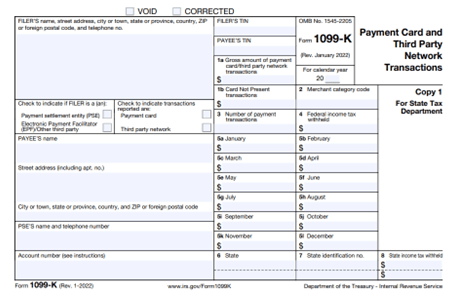
Amounts shown on this form are reported on line 1 of Schedule C.

If you run more than one business or side hustle in different industries, you’ll have to report 1099-K amounts on each respective Schedule C.

For example: if you sell video editing services on Fiverr, you have to file a Schedule C for that service. If you also do Uber on the side, that will require another Schedule C. So, the 1099-K form you receive from Fiverr will go on the Schedule C for that service; the 1099-K from Uber will go on your ridesharing Schedule C.

Fees:

Any fees charged to you by the company issuing you the 1099-K are not included in the form. To deduct those, you will have to report those on line 10 of Schedule C. Form 1099-K is a straightforward form. It reports the monthly amounts of either card payments or selling revenue you’ve received in the course of your business or side hustle for the year. Amounts reported go on the Schedule C, where you can also include any qualifying deduction you incurred while earning that money. 

U.S. SAVINGS BOND INTEREST

Series EE and Series I bonds are a considerably safe way to start investing. When you purchase a U.S. Savings Bond, you’re lending money to the U.S. government and the government becomes obligated to pay you back plus interest.

The IRS allows taxpayers two ways to report the interest. You can either report all the interest at once the year you cash in your bond, or you can report the interest every year. If you purchase both Series EE and Series I bonds, the method you use to report interest for one will apply to both types of bonds. You’re allowed to start paying interest every year if you had initially opted for paying all at once the year your bond is cashed. You’ll need permission from the IRS, however, if you wish to switch from paying interest every year to paying it all at once.

Typically, the person who purchases the bond is the person who must report and pay tax on interest earned. This is so even if the bond is registered to co-owners. If both co-owners purchased the bond, then interest is taxable to both owners. In cases when a bond is purchased for a child and is registered only in the name of the child, then interest is taxable to the child.

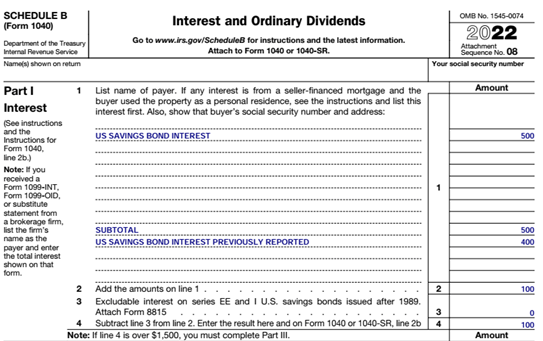
For those who choose to report interest the year of redemption, you’ll receive Form 1099-INT if interest is more than $10. Those who choose to report interest each year will also receive Form 1099-INT, however, an adjustment might have to be made on the return if paper bonds were purchased. This is because the Treasury method for processing paper bonds is not as efficient as it is for electronic bonds.

Adjustments are made on Schedule B. The following example shows how to make such an adjustment.

For more information on Series EE and Series I bonds, visit the Treasury Direct site.

The Tax Factor In Cash Value Life Insurance

Cash value life insurance is a type of permanent life insurance. It provides death benefits, as well as a savings feature. Each premium gets split into policy coverage and investment. It is this investment portion that provides the life insurance with its cash value.

Much of the interest in cash value life insurance originates in retirement planning. If it will provide sufficient supplemental income is something that a financial advisor and a policy agent can discuss.

Cash value life insurance grows tax-deferred. So, the interest it accumulates does not get taxed during the lifetime of the policy. Interest is only taxable when it is withdrawn. There are two ways to keep withdrawals tax-free.

One way is to withdraw amounts only from deposits made towards the premiums (or your cash basis), and not those made towards the cash value. This is considered a return on principle, and it is not considered income.

A second way is to withdraw in the form of a loan. A loan will not be taxable; however, you will owe the loan plus interest to the insurance company.

Caution: it is possible to go over with withdraws from your account and end up withdrawing from the cash value. The danger of this is that you may end up lapsing the policy. If this happens, and you happened to have accumulated a substantial cash value, interest will become taxable in the year you withdraw it. Cash value life insurance offers the option to surrender the policy. This is essentially a total distribution of the policy (minus any surrender fees the company charges). If proceeds were more than your cash basis, proceeds will be reported on Form 1099-R.

It’s important to note that cash value is only available on permanent life insurance, not term life insurance. Cash value life insurance premiums are higher than on term policies, along with policy and surrender fees. It’s important to be prepared with a list of questions when speaking with both an advisor and an insurance agent in order to avoid costly surprises down the road.

Where To Mail Tax Returns and Amendments

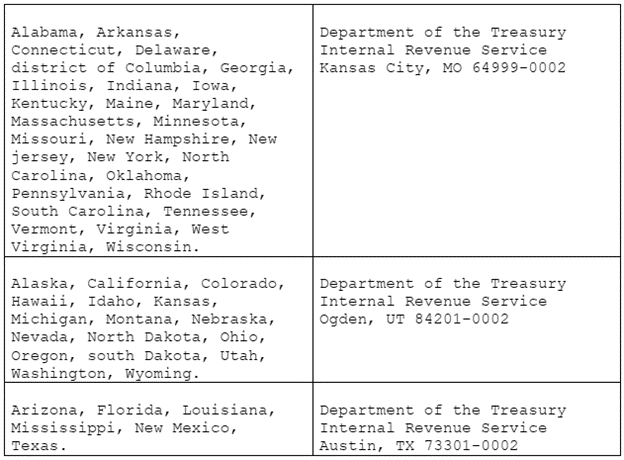
For tax returns expecting a refund, mail return to the address assigned to your state:

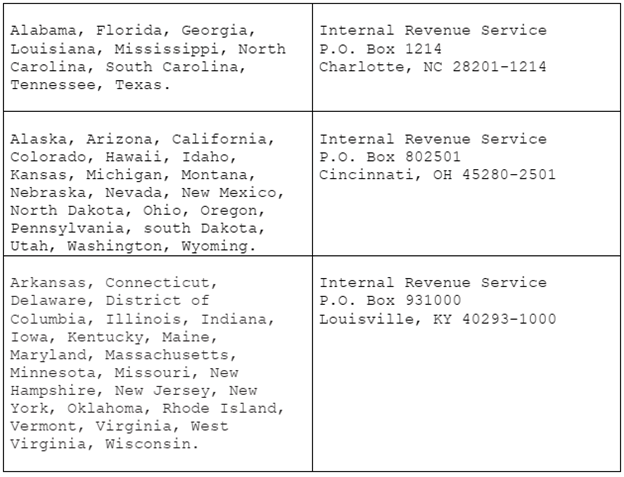
For tax returns enclosing a check or money order, mail to the address assigned to your state:

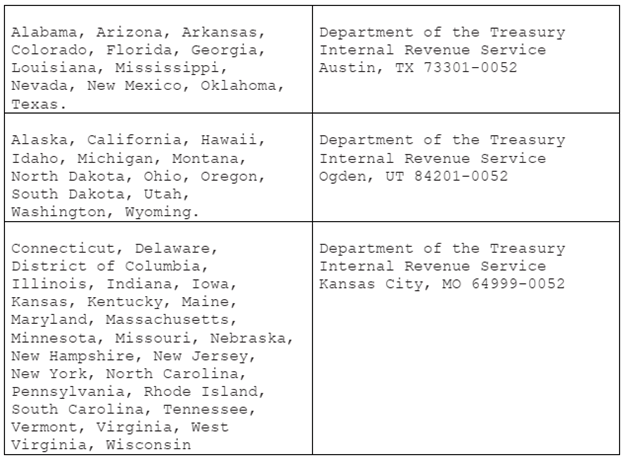
Amendments should be mailed to the address assigned to your state:

Note: When mailing a paper return or amendment, double-check you’ve signed. If you had a professional prepare the return, their signature must be on the return, as well. The IRS only accepts wet signatures on mailed returns.

What Happens When You Don’t File A Tax Return?

For many, filing a tax return is a requirement. It all boils down to a person’s filing status, age, and income.

So, what happens if you’re required to file but don’t?

If you’re due a refund you have three years to file in order to claim it. You’ll still be required to file your return; however, if you file after the three-year limit, you will no longer be eligible to receive that refund.

If you owe taxes and fail to file, the consequences can be more severe. The U.S. tax system is a pay-as-you-go system. We’re expected to pay our taxes as we earn our income, either through withholding or estimated payments. Every day we don’t file or pay our taxes past the tax deadline, penalties and interest accrue on that amount owed. We’re allowed to request an extension to file by October, but there is no extension for paying.

Section 6651(a)(1) of the Tax Code allows for a 5% “Failure to File Penalty” every month it isn’t filed. Section 6651(a)(2) allows for a “Failure to Pay Penalty” of .5% every month the tax isn’t paid. As of the 2nd Quarter of 2023, interest was kept at 7% for individuals (compounded daily).

It’s possible for the IRS to file a “substitute” return on your behalf. The IRS files such return using third-party reports such as W2s, 1099s, and any other tax documents submitted to them. You may lose out on credits and deductions if a substitute return is filed for you, potentially increasing your tax liability.

For those delaying filing a tax return because they owe, the IRS suggests filing anyway and requesting to be put on a payment plan. You can apply for a payment plan online or by calling the IRS at 800-829-1040.

Business Travel Expense Write-Offs

If you’re a business owner, you can deduct travel expenses you paid for yourself and your employees. Travel expenses must be for temporary travel away from your main place of business.

Temporary travel can be anything from one day to less than a year. In fact, it doesn’t even have to last an entire day, as long as the trip requires sleep or rest due to the demands of the work performed away from home.

“Home” is defined by the IRS as your “Tax Home” or in other words, your main place of business. If you have an office, that is your tax home. For those who work from home, your home office qualifies as your tax home. The three most important factors to consider in determining your tax home are:

1. Where you spend the most time while conducting work.

2. Where you get the most work done.

3. Where the most significant amount of income is produced.

If you operate from multiple locations these three factors will help you decide where your tax home is.

The IRS does not consider business travel going from where you live to your tax home. That is considered commuting. Cost of meals while at your tax home are also non-deductible.

Business travel expenses must be ordinary and necessary. The IRS cautions against deducting “lavish” expenses or any costs arising from personal use.

Deductible business travel expenses include: transportation (even if you used your own car) you have to take from your tax home to your business destination; meals and lodging; dry cleaning and laundry; any fares you had to pay to get from the airport to your hotel and from your hotel to your business destination. For a full list refer to Publication 463 by the IRS.

As with any deduction, burden of proof belongs to the taxpayer and records must be kept of all expenses paid for.